• How Storytelling can Change the Future: By Chris Nolan

    How Storytelling Can Change The Future  – What’s Wrong and How to Fix It.

    Written by Chris Sean Nolan, Multiple Emmy Director, Story Expert

    Destination: Protopia

    Futuristic Barbara Marx Hubbard said, “The future exists first in imagination, then in will, then in reality.”  She added, “As you see the future, so you act and as you act, so you become.”

    Well, what if we could imagine a world that is continually getting better, becoming more abundant, improving our livelihood and health, and creating unheard of opportunities and possibilities? What if that were, in fact, the world we are now living in? Then, according to Hubbard, we should all be acting and behaving with optimism and hope. Yet, the opposite is true. The world is awash in pessimism and fear of tomorrow. There’s a malaise, even a dread about the future.

    So, what’s the disconnect? Why is the real story of a better future not being told? Why is the truth so distorted?  And what’s that doing to our imaginations? Neuroscience tells us stories affect our physical and mental makeup on many different levels. Stories can change our brains and directly impact our thoughts, beliefs, feelings, and actions. They shape our world.

    So, if our brains use stories to make sense of the world then how are the unavoidable and increasingly apocalyptic news and entertainment narratives shaping our worldview? It’s no wonder we can’t possibly see any the good in the future. Or what Kevin Kelly, the founder of Wired magazine, calls Protopia. This isn’t Dystopia or Utopia but simply a future that is getting exponentially better and better.

    The Good, The Bad and Your Brain

    There’s a reason these negative stories stick with us. Human brains are evolutionarily wired to be nine times more negative than positive. The more fear-based the story, the more it catches our attention. Thus, the old newspaper adage, “If it bleeds, it leads.”

    Unfortunately, this negative default mode can prevent us from seeing the good in the world (or even ourselves). When we’re always in survival mode, we have a hard time grasping just how abundant our lives are and why this is an amazing time to be alive. Yes, we have enormous challenges: The looming consequence of climate change, continued water and energy needs, geopolitical and social unrest, a growing marginalised population, species extinction, and a need for greater empathy for all living things.

    But we’ve also doubled the lifespan of the average human, income around the world has tripled, and despite recent inflation, the cost of goods (food, energy, transportation and communication) has dropped 1000-fold. Global literacy has gone from 25 to 80 percent. Furthermore, technology continues to make things more available and sustainable by driving down the cost of food, energy, healthcare, and housing.

    Soon the entire planet of 9 billion people will be connected. When that happens the pace of innovation will be mind-boggling. AI will become ubiquitous and dramatically enhance human capabilities by allowing us to solve problems that have heretofore been unanswerable. But sadly, we don’t see progress. Because another neural glitch in our brain’s medial frontal limits our ability to comprehend the speed of exponential change.

    The human brain evolved in an environment that was local and linear. In our ancestors’ lives everything was a day’s walk away and the rate of change was very slow. Just over a century ago, the speed of a horse was as fast as information could travel. Now, if something happens on the other side of the planet, we hear about it a millisecond later. The world has not only become global but exponential. This new era is what I call VUCA MAX.

    VUCA MAX: The Future is Moving Faster Than You Think

    Massive accelerating exponential change really started kicking in around 2020 during a pivotal point in human history we weren’t prepared for. In my documentary: It’s VUCA: The secret to living in the 21st century, the mission was to help the world catch up to these radically changing times.

    VUCA is an acronym for Volatility, Uncertainty, Complexity, and Ambiguity. It was coined by the military in 1987 to explain the uncertainty of the 20th century and is a very apt way of explaining the conditions and environment of the early part of the 21st Century, in which we were witnessing Moore’s Law – every 18 months the power of technology was doubling – and transforming the world. It’s why the smartphone in your pocket is now a million times faster, a million times cheaper, and a thousand times smaller than a supercomputer on the 1970s.

    Now, the exponential convergence of Moore’s Law, Metcalfe’s Law, and Wright’s Law have created VUCA on steroids. The doubling is converging and compounding. VUCA is now Massive, Accelerating and eXponential. It’s now VUCA MAX. To give you an idea just how fast the future is moving, in the next 10 years we will see 100 years of change. In the next 80, we’ll see 20,000 years.

    Unfortunately, our evolutionary propensity for negativity and linear bias overwhelms us and leaves us vulnerable to our worst fears and distorted dystopian outlooks. It not only blinds us to the truth about the future, and how the future is more abundant that ever – but it also has an adverse impact on our mental health.

    Can Entertainment Save Tomorrow?

    There’s always been criticism of the news media and entertainment emphasising sensationalism and exaggeration over reality. Fear mongering and manipulation goes back to yellow journalism culminating with Orson Wells’ 1938 radio broadcast of a Martian invasion.

    Now, of course, we know that dystopian scenarios in movies and networks are fictitious. However, given our predisposition to fear and negativity, the entertainment media must be aware of and held both responsible and accountable for the creation and manipulation of the public zeitgeist. Going forward, I will make the augment that there are ways to dramatise narratives and even present dystopias, but still create a more balanced, realistic, and even exciting view of the future.

    Tomorrowland
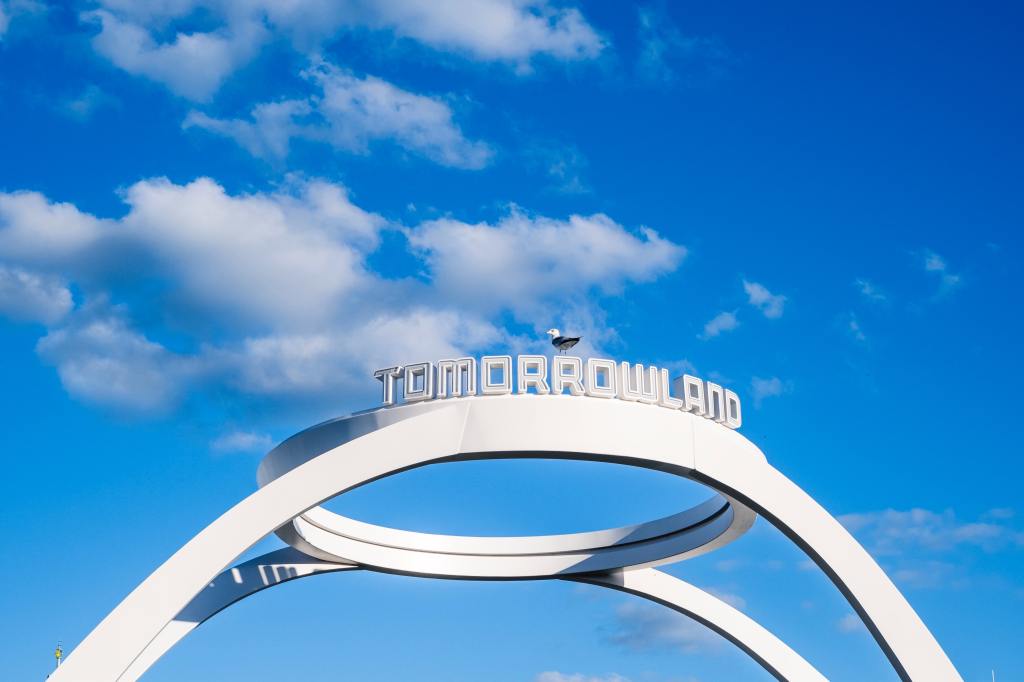
    “Tomorrow is a heck of a thing to keep up with.” – Walt Disney Walt Disney was a technological innovator, science fiction storyteller, and futurologist. He dedicated Tomorrowland with the words, “A vista into a world of wondrous ideas, signifying man’s achievements … a step into the future, with predictions of constructive things to come. Tomorrow offers new frontiers in science, adventure, and ideals: the Atomic Age, the challenge of outer space, and the hope for a peaceful and unified world.”

    As part of the Disneyland television show, Walt presented three one-hour “science factual” episodes that mixed humour with hard scientific facts to give the audience an exciting glimpse into the future.

    Let’s contrast that protopian vision with the 2015 movie, “Tomorrowland”. In the film, the antagonist sabotages humanity’s vision of the future by beaming horrific prognostications and the imminent collapse of the human race into everyone’s heads. And since our brains are wired to gobble up negativity and fearful information, the antagonist’s broadcasts easily transformed humanity into a pessimistic and hopeless populace without will, purpose, or dreams.

    Although the villain is a bit stereotypical, the theme and plot mirrors what’s happening in our world today. Namely, that a constant fare of grim, paranoid, fearful apocalyptic programming can’t be good for our heads.

    No Future Is Perfect

    Hollywood movies and TV haven’t always tilted toward dystopia. The classic sci-fi movie “2001: A Space Odyssey” had some dystopian themes (everyone remembers Hal) but it also portrayed the evolutionary development and limitless potential of the human species.
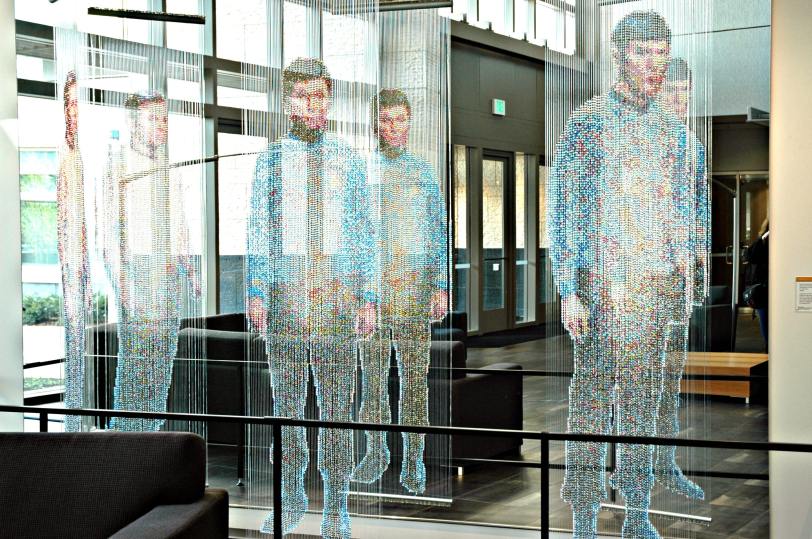
    Two seminal futuristic narratives of the 1970s, “Star Wars” and “Star Trek”, also had some dystopian story elements but overall, they were positive narratives with hopeful endings. Star Trek narratives took on many weighty themes including racism, religion, genocide, extinction, mental illness, sexism, morality, death, and time travel.

    And even though Star Trek took place in space, the stories were always allegories about life on Earth, which is why the Star Wars and Star Trek franchise have been charting a course for a hopeful future for half a century –– while many dystopian themed programming have exhausted their storylines.

    Where Is Our Lucy?

    Ironically, Star Wars and Star Trek were not easy sells. All but one studio turned Star Wars down and no major studio would touch Gene Roddenberry’s plan for a race and gender integrated crew representing the future of humanity. In fact, if it weren’t for Lucille Ball, there would be no Star Trek.

    Lucy had just divorced Desi and was now running their independent production company Desilu. Star Trek was sold as a western in space, but the pilot was rejected by NBC. The series was dead. But, because Lucy was now swimming in profits from reruns from “I Love Lucy”, she did something unheard of. She paid for a second pilot and is credited as the main reason Roddenberry achieved his positive vision for the future. 

    Some might say dystopias are an easier sell and perhaps even easier to write. Or as British Sci-Fi writer Brian Aldiss calls them, “cozy catastrophe” stories. Many are basically horror stories with simple plots and clearly identified evil. Protopias on the other hand build plotlines calling for deeper multidimensional layers, character development, and complexity.

    Positive Signs: It Can Be Done

    Cory Doctorow is one of the most relentless and inventive authors writing at the junction between speculative fiction and real tech. Doctorow is on a mission to inspire positive futures. “Protopia is not the assumption that nothing will go wrong. Being hopeful means believing that when things break down, we can rebuild them. It’s still possible to model positive future outcomes and have a dramatic story.” Doctorow adds, “Disasters are where we rise to the occasion. They are humanity’s best moments, when we sacrifice ourselves for others.” 

    This is one of the things we addressed in the documentary, “It’s VUCA. The Secret To Living in the 21st Century”, that in time of great chaos and uncertainty, people have always demonstrated the greatest fortitude, resilience, courage, and empathy for each other. Things go wrong. People make mistakes and disagree, especially concerning the criteria used to govern technologies or how to deal with big complicated, future challenges –– but we figure it out.

    A shining example of a Protopia film is “Arrival” directed by Denis Villeneuve based on the short story “Story of Your Life” by Ted Chiang. It’s about a linguist enlisted by the United States Army charged with learning how to communicate with extraterrestrials that have arrived on Earth before tensions lead to an intergalactic war. “Arrival” not only provides a window into what communicating with other sentient species might look like, but it also portrays aliens as bent on saving humanity rather than annihilating it.

    The Power Of A Single Image

    Even a single image can change the story.

    In 1966, the world was consumed by pictures of mushroom clouds and atomic bomb tests. The images of the nuclear blasts made people feel that civilisation was doomed. Being a photographer and activist, Stewart Brand knew that images change people’s behaviour. So he began a campaign for NASA to release an image of the whole Earth in space. 

    Brand even made-up buttons that asked, “Why haven’t we seen a photograph of the Whole Earth yet?”  When NASA finally released the image of the Whole Earth taken by NASA astronauts, this single, hopeful, beautiful image blew away the dark atomic clouds.

    People not only saw a brighter future but it helped create what became the transformative ecological movement. We were no longer passengers on a planet, we were the crew and responsible for its wellbeing. This one image changed the story from humanity is capable of destroying itself with technology to humanity is capable of discovering itself.

    Sixty Seconds To Protopia 

    As a branding and storytelling expert, I’ve had first-hand experience with the power of story and messaging. One of the best examples is Apple’s “1984” considered the greatest TV commercial ever made. It opens in a dystopian world that’s disrupted by a singular woman who hurls a sledgehammer at a giant screen displaying the Big Brother broadcast – destroying it. Not only did the revolutionary ad almost single-handedly bring computers into the mainstream, changing the world as we know it, but it defined in our minds Apple’s protopian vision of the future of technology.

    We now envisioned computers as empowering individuality and saving humanity from a bleak future of control. A control represented at the time by the giant computer behemoth Big Blue or IBM. Today, Apple is the most valuable company in the world whereas IBM no longer sells personal computers and is one-tenth the size of Apple. It’s a stark example of how the stories we tell about the future contribute to how we imagine the future, which in turn can become reality. 

    Bringing The Future Home

    Kevin Kelly, the founding executive editor of Wired and former editor and publisher of the Whole Earth Review (the descendant of Stewart Brand’s Whole Earth Catalog) postulates,  “Perhaps at this stage in civilization and technological advance, we enter into permanent and ceaseless future-blindness. Utopia, dystopia, and protopia all disappear. There is only the Blind Now.” Kelly continues to hope that our current future-blindness is only a passing phase that future-blindness is not an inescapable or permanent affliction of our modern world, which brings us back to storytelling.

    Once Upon a Time in America we were so excited and awestruck by the possibilities of the future that we celebrated progress with a worldwide story known as The World’s Fair The 1939 New York World’s Fair featured “The World of Tomorrow” and people came back from it proudly sporting buttons that said, “I Have Seen the Future.”

    I grew up in Seattle where The Century 21 Exposition in 1962 (also known as The Seattle World’s Fair) saw the construction of the Space Needle, now the iconic symbols of The Jet City.  Century 21 featured a futuristic monorail and a trip to a better “World of Tomorrow” which, ironically, was during the height of The Cold War. “The World of Tomorrow” began with a ride in the Bubbleator, a 19-foot diameter spherical Plexiglas elevator. General Electric and Johnson’s Wax built model home interiors that brought the future home. It explored the life of the woman of tomorrow, featuring a household with “push-button ease” for everything but changing the baby.

    World’s Fair’s partnered with leading American companies and entertainment companies to educate people about the future. At the 1964 New York World’s Fair, Disney debuted four major attractions including Ford’s Magic Skyway, It’s A Small World sponsored by Pepsi-Cola/UNICEF, Great Moments With Mr. Lincoln from the State of Illinois, and General Electric’s Progressland. These attractions eventually became part of Disneyland’s Tomorrowland. And, following their success, Walt moved forward with Project X, which would become EPCOT –– the Experimental Prototype Community of Tomorrow.

    These World’s Fairs helped humanity visualize, celebrate, and physically experience technological progress and the benefits of the future. Unfortunately, the last World’s Fair in the United States took place in 1984.

    A Way Forward: Urgent Optimism

    Jane McGonigal from The Institute For The Future believes, “This is a time for urgent optimism.” We need to flip the script on the dark future otherwise heading into the unknown has little value. In other words, we have to believe the struggle is worth it.  But to do this, the future needs champions.

    Whether the story is presented by an entertainment company, a corporation, a city expedition or an individual with a vision, we need to embrace Protopia narratives and experiences. Stories that become a force for The Good Future and positive stewards of renewed optimism. By guiding the world toward a more realistic view of the future, we empower people, especially younger generations, to believe things are getting better, not worse –– and give them hope and inspiration that they can meet the grand challenges of tomorrow.

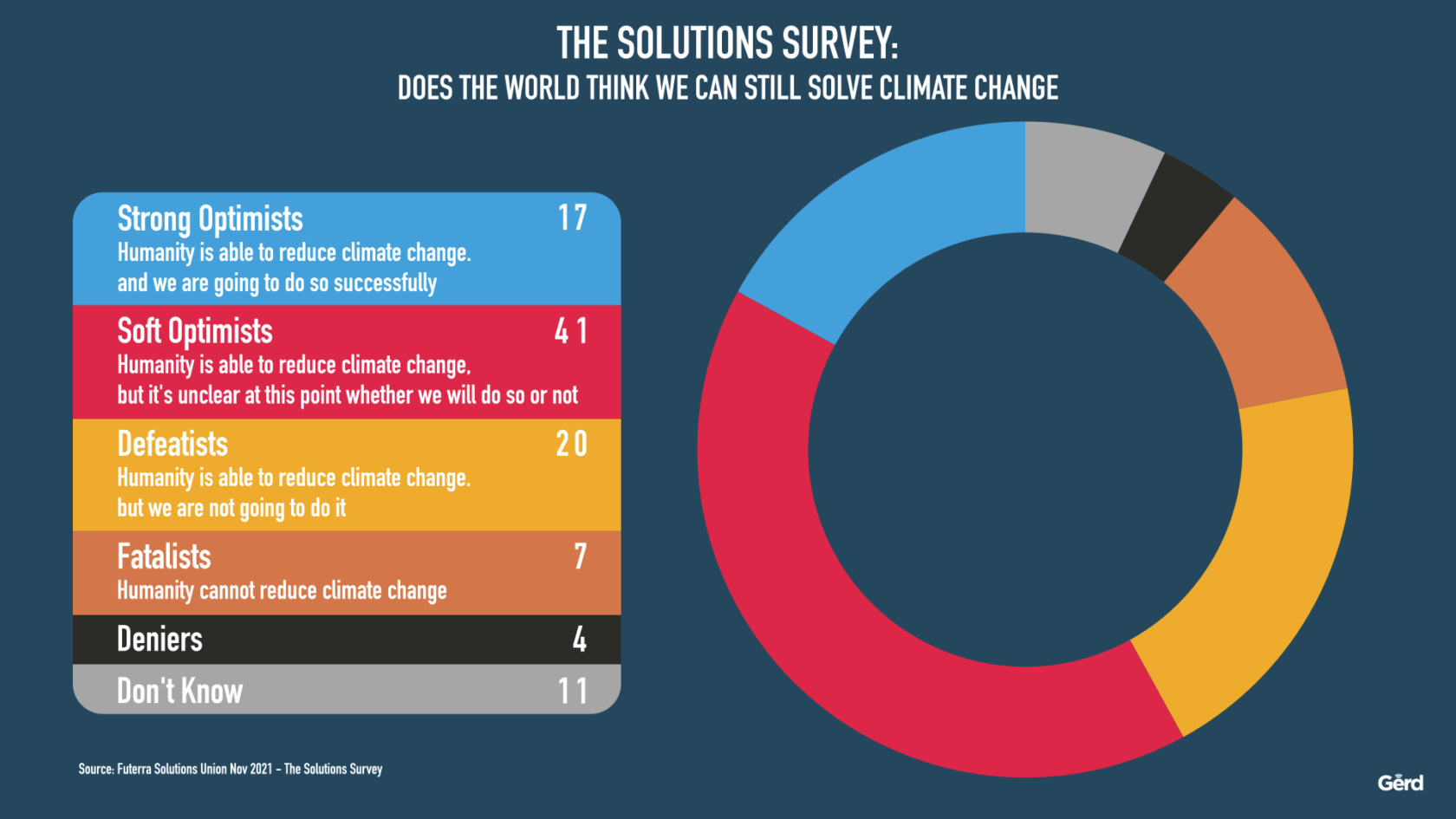
    Today, young people are chronically pessimistic and depressed about their future. In a recent survey of 16 to 25-year-olds in ten countries 70% said, “humanity was doomed”, which is why it’s more important than ever to behave as if the world is evolving not collapsing. It only takes one person with the vision and the right story to change the consciousness of the planet.

    As Barbara Hubbard said, “How we see the future determines our story, how we act, and become.” Let’s uplift imaginations toward the unimaginable possibilities and abundance ahead. Let’s reverse fear and the dystopian zeitgeist by creating stories that can change the world for the better and inspire bold vision and ambitious action.  And empower people to become the heroes of tomorrow’s stories.
  • Twice Upon A Time: Our World By 2030

    Check out the latest film about the future from Gerd Leonhard.

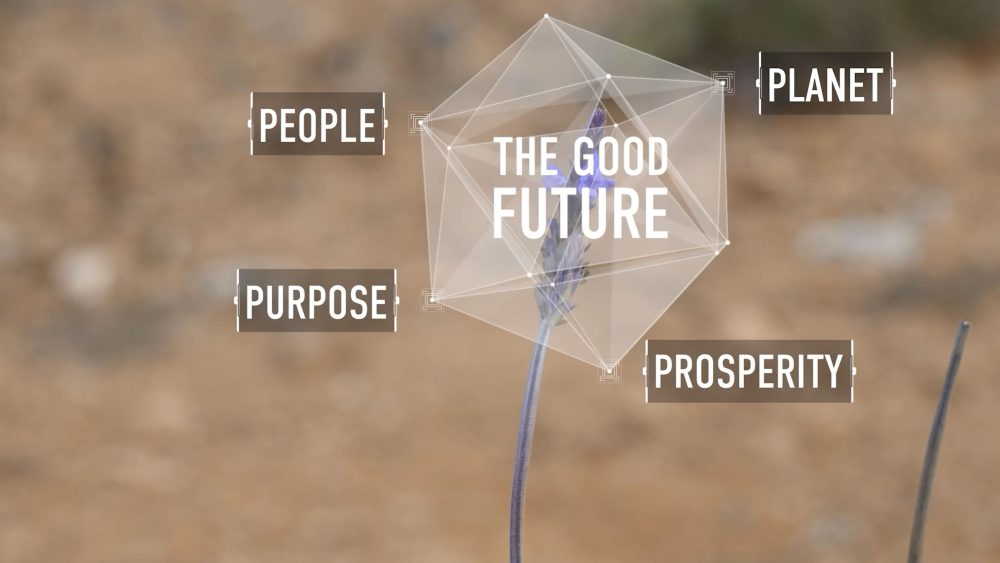
    This film is a passionate call for action to everyone, and specifically to all participants of #cop27egypt – we must act now to ensure #thegoodfuture ! Implement now, have courage!

    “Our attitude contains our future, and the choices we make today create our future.  We are to be architects of the future – not its victims.” Buckminster Fuller

    This fast-moving and (imho) riveting film depicts two alternate #2030 scenarios: the lousy future and the good future, covering topics such as #climatechange and the challenges of exponential technological change (yes, my fav #techvshuman topics), from both angles. At the end of the film, you’ll get to vote which one you think is more likely.

    Note: If you’ve seen enough dim views of the future already you can skip directly to the good future by using the 6th shortcut, below::)

    • 0:10 – Why I made this film
    • 6:15 – SKIP AHEAD to The Good Future (never mind all that bad stuff:)
    • 0:44 – Why we need to learn how ‘come back from the future’
    • 1:39 – The bad 2030 starts here
    • 2:30 – The Internet in 2030, derailed
    • 3:19 – Democracy under threat
    • 4:03 – More blah blah blah
    • 6:49 – One fried catfish (Startrek Replicator)
    • 8:59 – The revival of democracy
    • 10:18 – Sustainable is the new profitable
    • 11:23 – The future of mobility

    Please go here to take the poll or see the results

    More details and context: www.twiceuponatime.tv

    A Word from Gerd: 

    Let me start by saying that the future is not what it used to be! There have been many times in human history when the future seemed utterly uncertain, or (of course) dark and dystopian. But there has rarely been a time when so many people around the world question the future in such a fundamental way, as they do today.

    The Danish philosopher Soren Kierkegaard once said that life must be lived forwards but can only be understood backwards. Well, that may have been true in 1845, but nowadays I think we must learn how to ‘remember the future’; to travel forward 7 to 10 years, and to then return with what we’ve learned …. in order to make better decisions TODAY.

    Hence, I humbly present this film, taking us forward to 2030, twice: the dark and lousy future and the more heavenly one. 

    You may ask: What’s the point of even envisioning a good future when the present is already such a hopeless mess? Well, I think it matters a lot HOW we think about the future – because “as we see the future, so we act, and as we act, so we become”, in the words of American futurist Barbara Hubbard.

    Many thanks to Sylvain Collet (Editor and Co-Producer) and James McCabe (Scriptwriter)

    Music

    • Sad Dramatic Folk Ambient – AudioZen (via Envato)
    • Via MusicBed.com
    • Going North (No Oohs & Ahhs) – Daniel Deuschle 
    • As the Land Sleeps – The Echelon Effect
    • Amber Light – Shawn Williams
    • Coming Home – Zachary David
  • Talking Across Differences: A Paradigm for Raising Consciousness by William Halal

    By William E. Halal, The TechCast Project, George Washington University

    This article focuses on one of the great challenges facing all of us today – how can we resolve the raging conflicts fomented by social media?

    Conflict has always been a problem, but the digital revolution has raised it into one of the great challenges of our time. Facebook and other social media platforms inherently provoke the differences that drive today’s wave of “post-factual” nonsense. Statistica reports that 70 percent of Internet users think fake news causes confusion, and 83 percent say disinformation harms politics. One analyst framed the problem this way:

    “In the past, wars were conducted with weapons. Now it’s through social media.” 

    It gets worse. Smartphones, social media, and artificial intelligence are automating the “objective” knowledge that computers excel at – thus pushing attention into the “subjective” realm governed by emotions, values, beliefs, and higher-order thought. The focus today is rarely on rational solutions, but more on resentment, self-interest, power and other motives beyond knowledge altogether.

    Norman Lear, the famed TV producer, said: “We just may be the most-informed, yet least self-aware people in history.”

    It is common to see wars fought over “us vs them” and “good vs evil.” Many Americans are convinced that battle between opposing parties is the best way to produce sound policy. After decades of political gridlock and rock bottom confidence in government – really? Is this the best we can do?

    This is an historic challenge requiring a major shift in consciousness. My study of social evolution shows that the digital revolution is driving the world beyond knowledge into a new frontier dominated by the subjective thought that makes up nothing less that consciousness itself. (www.BeyondKnowledge.org) Whatever one thinks of former President Trump, for instance, he is a master at shaping consciousness. After all, it takes special talent to convince 74 million Americans (~ 90% of GOP members) to believe the 2020 election was stolen. That is the power of consciousness.

    Ironically, the Trump saga highlights how the world is entering an Age of Consciousness, though it’s struggling through confusion, disinformation, climate denial and other threats that pose an existential crisis. Henry Kissinger recently wrote in Time: “… we are moving into a new period of human consciousness which we don’t yet fully understand.” 

    Just as Gutenberg’s printing press unleashed a flood of information that led to decades of war and the Protestant Reformation, today the digital revolution challenges us to tame the power of social media into a form of global consciousness. A good place to begin is by learning to talk across differences. We must make this the basis of social life.

    Learning how to talk productively would be revolutionary, and it seems essential. With social media becoming more pervasive and cultural differences sharpening, the only way to find peace is through understanding one another. Former US president Trump may be out of office, but his 74 million followers remain a powerful force. Rather than more shouting, this article suggests it would be better to listen to them carefully.

    A large body of creative ideas is growing on how to handle seemingly impossible situations, usually focusing on a few central principles. The following 5 points sum up the best thinking on what can be seen as the basic “cycle of conversation” –

    1. Agree on the context for conversation,
    2. Caution the speaker to avoid provocation,
    3. Calm the listener to understand fully,
    4. Guide the respondent to be constructive, and
    5. Conclude with learning and trust.

    A recent study conducted by the TechCast Project shows that this process appears to be 73 % effective by increasing collaboration, reducing conflict, and improving understanding. Results vary markedly in different settings. The most appropriate sectors are Business – 73 %, Education – 71 %, and Families – 69 % — cases that tend to value knowledge, objectivity, and cohesive relationships. Whereas Politics – 48 %, Religion – 40 %, and Social Media – 37 % are less conducive because of subjective differences in emotions, values and beliefs.

    1. Clarify the Context to Form an Agreement

    If you are engaged in a business meeting, an academic seminar, a political debate, or even a friendly discussion, you will inevitably be talking within some context. It could be Roberts Rules of Order or simply an informal understanding about how to behave. We may not think about it, but all communication requires understanding the context in which a message is embedded.

    Today we need a context that allows us to communicate across the vast divides that cause confusion and conflict.  Some ground rules, guidelines, or agreement are essential before engaging in a serious discussion to create trust and speak openly. A safe space that fosters communication. It would help greatly if these rules were commonly understood in simple terms – “speaking from the heart,” “really listening,” or simply “talking across differences.”

    1. Caution the Speaker to Avoid Inflammatory Language.

    As much as one would like to ventilate harsh feelings that been harbored too long, we must learn to bridle this temptation if we hope to have a listening audience. Talking across differences requires avoiding anything that is inflammatory — no blaming, accusations, loaded words, or anything that is likely to provoke conflict. 

    This is a demanding responsibility as most of us are prone to indulge our egos. That does not mean all emotions are curtailed, but that they are not directed negatively. If we wish to start a useful dialogue instead of an argument, it’s essential to speak from a deeply personal place. Almost spiritual. That place where you struggle to understand a complex world. Where you see how others, even enemies, also struggle to cope.  That we are all flawed, doing our best, although different. Humility helps. Almost any speech can be accepted if authentic emotionally, coming from our shared humanity. Respectfully.

    1. Calm the Audience with Deep Listening 

    It helps to acknowledge that “really listening” is hard work. It has been called “emotional labor.” Listening requires that we yield our impulse to argue, fight back and other bad habits acquired to help retain a sense of personal control. To listen deeply we must surrender this need for control and open ourselves to a richer reality. Release expectations, prior judgments, defensiveness, anything one is holding back. In religious terms, this might be thought of as showing obedience, or compassion for others’ suffering. We must allow ourselves to become vulnerable to things that may hurt. We must be prepared to make the ultimate concession by changing ourselves.  Otherwise, “we are likely to pass God by without even noticing Him/Her,” according to Father Richard Rohr.

    If we can truly cleanse our minds, then we are receptive to the value of differences you may dislike, including enemies.  One of the foundations of psychotherapy is that the very act of listening to a troubled person can diminish the problem. In other words, simply being truly heard is healing. People can open up dramatically when feeling understood and accepted. Real listening and fully appreciating others’ views can become a creative force for change.

    1. Guide the Responder to Explore Constructively

    Talking across differences is not passive but requires constructive responses.  A sure-fire way to stop a conversation is to throw up obstacles. There are innumerable ways we deepen conflict, but we can avoid these traps by catching ourselves from responding with “I disagree,” I object,” “You’re wrong,” “But…”, “What about…” Any type of objection divides, provokes resistance, and sheds trust.

    Constructive questions that honor the speaker’s points can form a dialogue with the common goal of understanding. If we can join the speaker in helping to explore his/her concerns, we then create a breakthrough in the relationship.  Speaker and listener are united in seeking truth. They form a small, temporary community. Mutual understanding is a path to resolve conflict. 

    1. Conclude the Relationship in Learning and Trust

    The above principles comprise only a theory of peaceful conversation. As much as we all try to avoid conflict, there is limited experience in actual practice, and it’s not possible when caught up in violent conflicts.

    Whenever we meet in the hope of pursuing some goal, however, there always exists an opportunity to improve understanding. Discussing differences honorably is done often today in academic settings, good business meetings, and among friends. A more extreme example is Quaker meetings; sitting in silence, anyone is free to speak as the spirit moves them. Talking across differences could prove a breakthrough in today’s embattled politics by enabling centrist solutions that benefit both sides.

    Done well, a productive conversation can replace antagonism with respect. There may remain points of disagreement, but it is possible to see them as assets in disguise.  Rather than a source of contention, differences can be like poles of a magnet or electrical current. They can become a source of energy, of creative acts that open new vistas for change and growth.

    Beyond the practical gains, talking across differences unites us in community of shared understanding. If we speak from the heart, listen deeply and respond constructively, the collective intelligence can replace conflict with trust and consensus on solutions to what seem intractable issues.

    At the risk of appearing grandiose, it may even be possible to think of this as the basis of a “learning society.” By raising the consciousness of a critical mass of individuals, talking across differences could be the best means for the global consciousness needed so badly today.

    Also see the podcast by Gerd Leonhard and Bill Halal.

    Portions of this article are adapted from Bill’s latest book — Beyond Knowledge: How Technology Is Driving an Age of Consciousness. 

  • The Future Is Better Than We Think
  • Don’t be a doomer! Good read via Noah Smith

    via Noahpinion

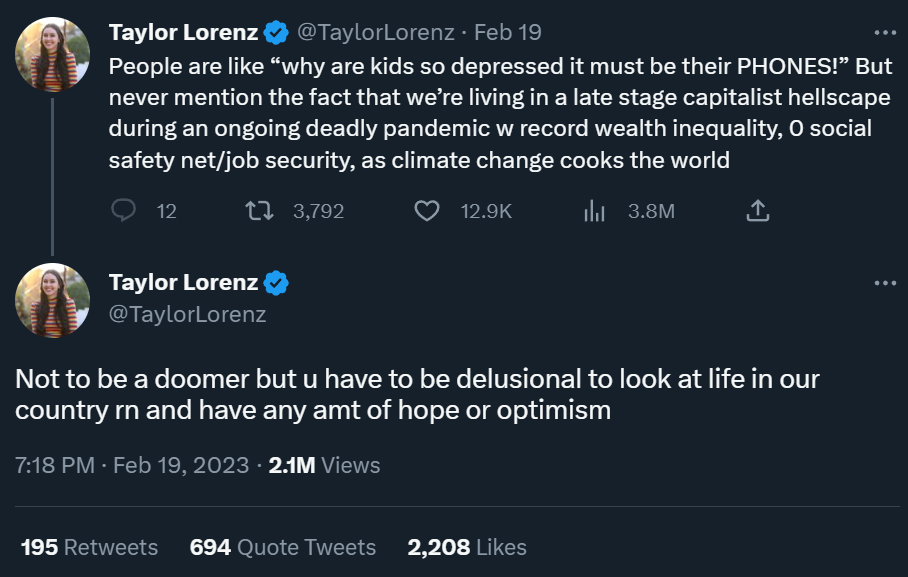
    “For a while now, the media has been debating the cause of a wave of teenage unhappiness in the U.S. The other day, the Washington Post writer Taylor Lorenz posted a series of tweets in which she argued the main reason teens are unhappy is simply that they realize the world around them is a “hellscape”:

    Now, as someone who has struggled with clinical depression for two decades, I’ll be the last person to tell the good people of the world to buck up, turn that frown around, and realize that everything is going to be OK. Because in a deep sense, it’s not going to be OK — we’re all going to die, and almost all of us will do so without accomplishing at least some of the things we wanted to. Many grievous injustices will go unpunished, many terrible things will happen to good people, and many empires will strike back without Jedi ever returning. You’re probably a worse driver than you think you are. The sun will grow and swallow the Earth, the stars will wink out, and the Universe will inexorably decay into meaningless noise.

    Let’s forget about the heat death of the Universe for a moment (which in my experience is the only good way to deal with it), and talk about the specific stuff that the doomers are dooming about. Most of it is just not nearly as bad as they say. Many Twitter users rushed to point out all the flaws in Lorenz’ claims.

    The default dooms aren’t so dire

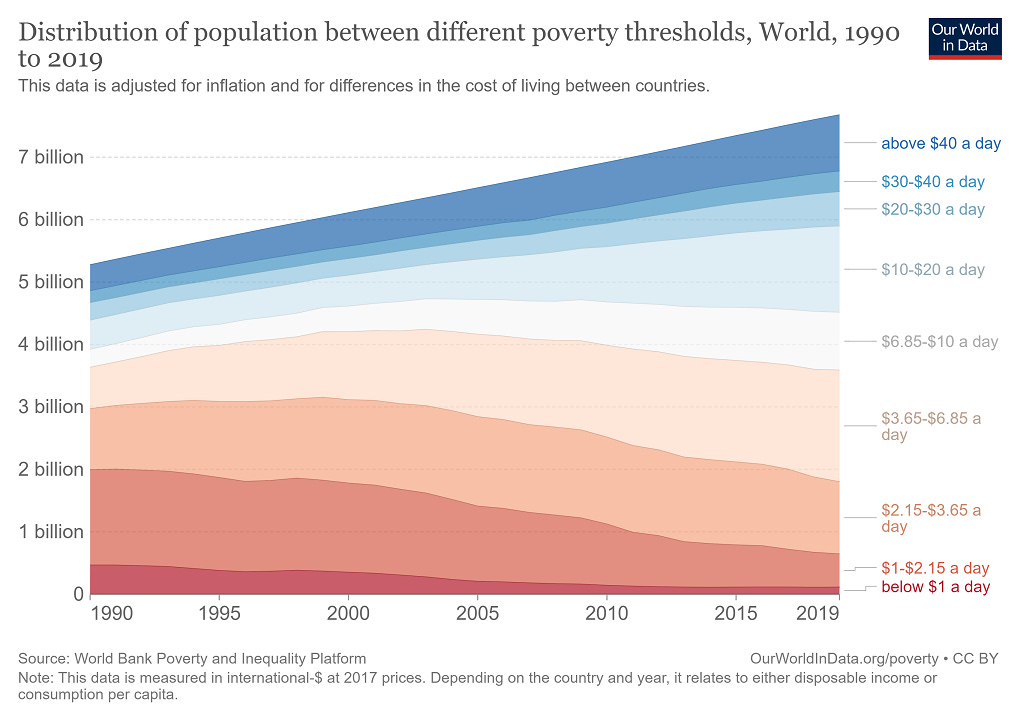
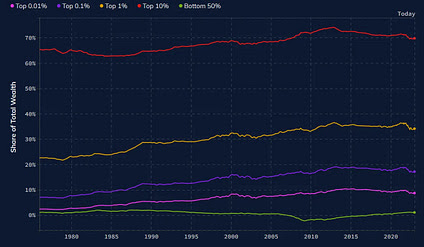
    First, let’s talk about “late capitalism”. This term is a holdover from the days when lots of people really believed in a Marxist version of historical destiny, in which capitalism would ultimately destroy itself from its own contradictions and socialism would inevitably succeed it. Yet somehow capitalism just keeps getting later and later, and the prophesied self-destruction keeps not happening. In fact, quite the opposite. Even as capitalism has conquered the world, humanity is richer now than it has ever been, and for the last three decades income growth has been concentrated in low-income countries. Poverty is down at every level, not just in rates but in absolute numbers. Wage inequality is down a bit as well, with wages rising strongly for low earners since the mid-2010s. This is at least partly a result of the fact that practically everyone who wants a job in the U.S. has a job.
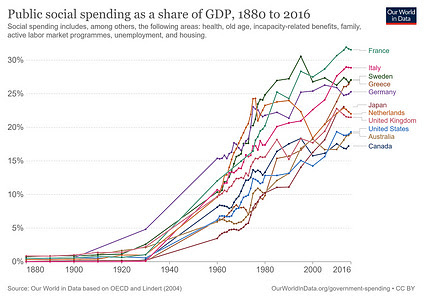
    Lorenz is extremely wrong when she claims that the U.S. has “0 social safety net”. As you can see from the chart, U.S. public social spending has risen steadily as a share of GDP. We have Social Security, SSDI, Medicare, Medicaid, unemployment insurance, Section 8 housing vouchers, SNAP, the EITC, the child tax credit, and many other safety net programs. This safety net does leave much to be desired — I would much prefer that this thicket of targeted benefits be simplified by giving people cash, and that onerous and usually pointless work requirements be repealed. But to claim that the U.S. has no social safety net is to promulgate fantasy. And this safety net has real and amazingly positive effects:

    Many forecasters now expect the peak of annual global emissions to occur in the next couple of years. And meanwhile, our institutions of science, industry, and government have now all been alerted to the danger, and are pouring increasing resources into the green energy transition.

    In other words, climate change is definitely going to be a bumpy ride for the planet, and it’s not yet certain that we’ll defeat it in time to save ourselves from major harm. But recent progress is extremely encouraging…

    Doomerism is a psychological tendency that must be constantly and actively resisted. And in the modern day, that’s no easy task. Plenty of research shows that negative news is more attention-grabbing than positive news. And with the advent of social media, it’s not just click-hungry media outlets bombarding you with negative news — it’s every clout-chasing 2000-follower account hoping for their big break. There’s always plenty of bad stuff going on in the world, but now there are literally millions of people with an incentive to find every bit of that bad stuff and shove it directly into your face, hoping you’ll reward them with a retweet or a follow…. Read more here

    .

  • The Threat to Higher Education: Who’s to Blame for Endangered Careers? – by Juan Alvarez

    via TheJuanAlvarez

    “As technology advances, certain professions and university degrees that were once considered secure and reliable are now facing significant threats. The invention of simple yet powerful tools has raised questions about the responsibility of various stakeholders in this shift”.

    “The law of Moore states that the number of transistors on a microchip doubles approximately every two years, leading to an exponential increase in computing power. If we apply this law to education, it becomes clear that traditional education is falling short. The rapid pace of technological advancement means that the information and skills taught in the classroom today will quickly become outdated, making it necessary for the educational system to keep pace with the changing needs of the workforce”.

    “The truth is, there are no easy answers. The responsibility for ensuring that professionals and students are equipped with the skills they need for the future lies with everyone involved in the education and workforce system. From universities to government agencies, from industries to labor unions, all stakeholders must work together to ensure a bright and prosperous future for the next generation. Failure to do so could result in a workforce that is ill-prepared for the challenges of tomorrow”.

  • Chat GPT: The Over-Hyped Threat to Skilled Labor and the Ignored Threat to Unskilled Labor – (Juan Alvarez)

    via TheJuanAlvarez

    “The recent launch of OpenAI’s Chat GPT has generated a heated debate about its impact on the “skilled” labor market. On one hand, there are concerns that it may threaten job positions at the top of the labor pyramid, particularly in areas such as consulting and research. On the other hand, it is argued that automation and AI can improve efficiency and free workers from repetitive and dangerous tasks at the bottom of the pyramid. However, while the media has been quick to jump on the former narrative, the latter is often neglected, despite having the potential to put millions of jobs at risk”.

    “The impact of technology on the labor market is complex, and it is not always straightforward. The automation of low-skilled jobs can lead to job losses, but it can also lead to the creation of new jobs. The impact of Chat GPT on the labor market will depend on how it is implemented, and how society responds to its impact”.

    “The launch of Chat GPT and the development of autonomous vehicles highlight the importance of having a balanced and informed discussion about technology and its impact on the labor market. It is essential to have a balanced and informed discussion about its impact to ensure a just and prosperous future for all of us”.

  • We Need to Radically Rethink Conscious Awareness (by Charles M. Johnston M.D.)

    Contribution by Charles M. Johnston, M.D.

    Respected thinkers have lately been putting forward more dynamic explanations for the workings of conscious awareness. In each case, there is the claim that the picture presented is fundamentally new. In my book Creative Systems Theory: An Overarching Theory of Purpose, Change, and Interrelationships in Human SystemsI note how Creative Systems Theory put forward a particularly nuanced such explanation over forty years ago. Arguably this explanation goes beyond even the best of current interpretations.

    Consciousness Awareness and the Free-Will-Versus-Determinism Debate

    The book uses the free-will-versus determinism debate as a way in. As commonly conceived, it fundamentally challenges usual understanding. You would not be reading this article, and I would not have written it if we did not believe in free will in some form. Yet basic cause and effect, at least as classical science conceives of it, describes a deterministic world. Free will and determinism each seem self-evident, but limited to the assumptions of Modern Age thought they imply mutually exclusive realities.
    The needed new picture follows from what Creative Systems Theory calls Integrative Meta-perspective, the kind of conceptual vantage that produces what the theory calls culturally mature understanding. Integrative Meta-perspective alters how we think about conscious awareness. It also makes possible a creative frame and how it changes our experience of determination.

    I began my extended piece in the book by describing a television series in which physicist Stephen Hawking makes the standard classical science argument that free will is an illusion. I propose that while this conclusion follows logically from accepted assumptions, it really doesn’t hold up to scrutiny. And I describe how familiar beliefs about free will just as much fail the test of considered reflection—at least reflection when made from the vantage of an Integrative Meta-perspective.

    The simple fact that the free-will-versus-determinism debate takes the form of polarity at least suggests that a more systemically conceived picture should be possible. And the fact that we can understand positions in terms of polarity’s underlying symmetry and the kinds of intelligence that polar advocacies most draw on further supports this conclusion. Humanist and spiritual sorts are likely to emphasize freedom of will, while more scientific and behavioral types are apt to emphasize deterministic conclusions and give will diminished significance or dismiss it outright.

    For these brief reflections, I will draw on a more specific polarity-related observation. A simple way to think about the free-will-versus-determinism debate and how it might be reconciled turns to the recognition that Modern Age beliefs about both will and determination have been directly tied to how we have viewed the relationship between mind and body. In modern times we’ve conceived of mind and body as separate. We’ve also seen each functioning according to basic rules of cause and effect. In this world, awareness is “captain of the cellular ship”—free and unfettered. And the body, as anatomy and physiology, functions according to basic engineering principles. Free will and determinism each have their own separate, rationally understandable realities.

    Cultural Maturity’s cognitive changes reveal a picture that is more of a whole, more expressly systemic. It is also a picture in which mind and body each come to function according to more dynamic principles. With Integrative Meta-perspective we come to appreciate that while awareness helps facilitate possibility, by itself it doesn’t determine it. And we leave behind thinking of the life of the body only in mechanistic terms. We find a more expressly creative reality all the way around, one that fundamentally alters the free-will-versus-determinism debate.

    The fact that a larger reality might exist is more a part of our daily experience than we might imagine. Certainly this is true for conscious awareness. Few truths become more obvious when practicing the craft of the psychotherapist, for example, than how different the reality of conscious awarenessis from how the conscious mind tends to view itself. (Comic Emo Philips once quipped: “I used to think the brain was the most important organ in the body, until I realized who was telling me that.”) The fact that conscious awareness is limited in what it can grasp is exactly as it should be. Much of our functioning works best without volition’s interference. (Recall Kipling’s centipede who walks gracefully with its hundred legs until praised for her exquisite memory.)

    I think of my own experience as a writer. Some of my best insights wake me up in the middle of the night. I also get a lot of my best ideas when on road trips, while driving through a mountain pass, or along the ocean. Insights often come unbidden. Sometimes they relate to topics that I had not before even considered. Certainly, they are not products of “will” as we conventionally think of it. And such experiences reveal conscious awareness to be a rather fleeting basis for identity. At the least, awareness comes and goes with sleeping and waking. But at various times, it can also provide very different views of reality.

    The Life of the Body

    In a similar way, a more systemic kind of understanding is coming to permeate the best of thinking about the body. As we learn more deeply about the complex workings of the endocrine system, for example, or about connections that exist between the gut and cognitive functioning, we find not a mechanical body, but a living body. And when we look more psychologically, we find a body that is in important ways intelligent.

    A simple thought experiment helps make the result when we think more systemically about the body more concrete. Imagine a gifted running back in football making his way down the field, rapidly cutting this way and that. The running back’s cuts take place more quickly, and in ways that are more nuanced, than could ever happen by consciously choosing them one at a time. The conscious aspects of intelligence simply aren’t built to function that rapidly or complexly. Does this mean, then, that the running back is not choosing? And, more specifically, does it then mean that, because his body moves before he “chooses,” what we witness is nothing more than mechanical reflex following the rules of a deterministic world? Such interpretations leave us with a less than convincing picture. At the least they leave us with bothersome questions. Are the outcomes of games then predetermined—or, alternatively, perhaps random? Either way, we are left wondering why we would attend a football game—and perhaps feeling a bit duped. I think the problem lies with the fact that our explanations really don’t hold up. Clearly in the running back’s movements we witness something that is not just vital, but intelligent, and profoundly so.

    Integrative Meta-Perspective

    Integrative Meta-perspective provides a more conceptually demanding—but also ultimately simpler—interpretation when it comes to both conscious awareness and the life of the body. In the process, it also fundamentally alters how we understand both human will and the dynamics of determination.

    With the recognition that the greater portion of our psychological functioning happens well outside of awareness, conscious awareness— and with it will—comes to have a new, at once more humble, and ultimately profound, role. Rather than willfully determining our actions, it serves as a facilitator and catalyst for intelligence’s richly creative workings. Integrative Meta-perspective reveals that while thinking of free will as free and willful in the unfettered sense implied by our Modern Age may once have benefitted us, today it gets in the way of fully appreciating choice’s ultimately more powerful and creative contribution.

    With regard to the body, Integrative Meta-perspective in a similar way offers a more interesting and ultimately powerful picture. We come to see the body not as a separate deterministic machine, but as an integral part of who we are as living—and specifically human—beings. A creative frame makes this result more explicit. We recognize how body sensibilities represent a critical, multilayered aspect of intelligence’s larger workings. We also better appreciate the rich complexities of its contribution in those workings.

    Creative Systems Theory proposes that the Modern Age free-will- versus-determinism debate has been a product of a developmentally appropriate, but systemically incomplete view of the world. It has been based on a falsely framed dichotomy, a juxtaposing of alternative determinisms that together have served to protect us—as polar explanations of every sort do—from life’s ultimately rich, but also easily overwhelming uncertainties and complexities.

    Integrative Meta-perspective reveals that free will is not so free— nor as much ours to direct—as those of an individualistic bent might prefer. And neither is determination as predetermined as advocates of either a more scientific determinism or the determinisms of religious faith might wish. The more systemic picture that results makes outcomes less readily anticipated, but the particular way that it does also makes outcomes ultimately more significant. While we lose the order of one thing guaranteeing another, we get in exchange the more generative sort of order that makes existence vital. We get creative possibility, and as humans, the particular kind of creative possibility that makes us who we are.

  • Brave New World 3.0 – by Tim Cole

    By Tim Cole

    Will the Metaverse be the new Internet, or will it be a flop like Second Life? This is far more than an academic question among nerds because it’s about money – a lot of money. In the last quarter alone, the Reality Labs division, which is working on the Metaverse, posted an operating loss of nearly $3.7 billion (currently 3.67 billion euros). Since the beginning of the year, a deficit of $9.4 billion has accumulated – on sales of $1.4 billion in the division.

    So, did Mark Zuckerberg make a massive speculation when he renamed his company Facebook to Meta? No, said Dr. Thomas R. Köhler and Julia Finkeisen in their new book, “Chefsache Metaverse” – on the contrary!

    The Metaverse has what it takes to be the “Next Big Thing.” Together with blockchain, cryptocurrencies, NFTs (non-fungible tokens) and other technologies, it is at the heart of what the authors call “Web 3.0”, which they say will dramatically change the way we communicate, interact and ultimately live.

    But doubts abound. As the authors admit, 74 percent of those surveyed in Germany in 1922 had never heard of the Metaverse. Only 3% could – by their admission – explain well what is meant by it at all. “Something to do with virtual reality” would probably be all that the majority of Germans would currently have to say on the subject.

    Yet, the Metaverse is not all that new. The term was coined in 1992 in Neal Stephenson’s science fiction novel Snow Crash, in which humans interact with each other as programmable avatars and software agents in a three-dimensional virtual space that uses the metaphor of the real world.

    The best possible combination of physical and virtual worlds, its supporters say, will allow us to live in the world behind the screen. In the future, we will invite our customers to meet in a virtual showroom, where they can see everything on their own. Virtual events, exhibitions, and marketplaces will bring us together without us having to get up from our office chairs. Hybrid workplaces will enable the benefits of remote work in the home office and mobile work with regular visits to the corporate office to collaborate with others. Sales meetings and product presentations can be conducted from the desk. Digital twins will revolutionize decision-making as a virtual representation of an object or system, along with real-time simulation and machine learning in enterprises.

    Brave new world, then? Even though Köhler and Finkeisen are clearly holding back so as not to fall under the suspicion that they are merely stoking the hype about the Metaverse, they nevertheless seem to be convinced that something huge is brewing here.

    But since German managers probably still lack the imagination to come up with concrete solutions for the Metaverse in everyday corporate life, they would prefer to take the dog to the chase. While, in the opinion of the author of this review, her book spends far too much time defining terms and looking back, it becomes really concrete – and interesting – from the halfway point. That is when it comes to concrete fields of application in individual business areas. Whether in retail, finance, production, logistics and distribution, the automotive or toy industry, or in travel and tourism: Wunderland is everywhere! Even the church and the art scene get their share of virtual reality, not to mention sex and dating. No area will be spared, the writers believe. And they are also getting down to the nitty-gritty.

    Take retail, for example, German retailers are still keeping a low profile, but luxury brands such as Gucci, Louis Vuitton and Dior are already heavily involved. Gucci has sold a virtual handbag on the Roblox platform for $4,100, and Louis Vuitton has launched a virtual game with quizzes, prizes, and surprises to mark the 200th birthday of its founder. The Japanese company ZoZo had developed a technology that allows customers to create a 3D model of their body at home. This was accurate to within a few e-millimetres, which provides the basis for a future shopping avatar that can visualize everything in detail from the drape of the folds to the fit of the sleeves of a T-shirt – perfect digital fit, that is.

    Otherwise, however, the yield of concrete applications for Metaverse in retail is quite meagre – clearly because retail is still in its infancy. The authors have to fall back on older examples such as Ikea’s from 2022, where augmented reality (AR) allows users to erase their furniture from an uploaded photo and replace it with models from the Swedish furniture giant.

    When it comes to the manufacturing industry, they unceremoniously replace the Metaverse theme with digital twins – not exactly new either, as they themselves admit. For quite some time now, the simulation of technical systems and even entire factories have been the subject of mostly talk, and rarely of action. If it is, then it is mostly about maintenance or early detection, for example where the Digital Twin can detect errors in good time, even before a failure occurs. The book does not discuss the exciting topic of “human digital twins”, where humans become part of the simulation, possibly utilizing a feedback loop, which could enable doctors, for example, not only to recognize diseases but also to treat them. But we’ll have to wait for the next edition for that.

    Where the authors really shine with their knowledge, is in education and training. Indeed, there are concrete success stories to tell, such as the example of the US engineering service provider Honeywell, where experienced employees are connected with young colleagues through mixed reality headsets to pass on their experience remotely, or the Zurich police, which has allegedly already had 400 officers successfully complete VR training. Admitting that these VR and AR applications are basically just “Metaverse light”. But they supposedly clearly demonstrate the democratization of the underlying technologies, as well as the momentum behind this topic.

    The author’s excursion into the area of online dating and cyber sex is appealing. Finally, online porn is gaining a significant boost thanks to VR and Metaverse. “Sex sells”: the old motto still applies. When the porn industry adopts a technology, insiders consider it a surefire sign of its imminent breakthrough. But the Metaverse also promises to revolutionize the world of dating. Just as speed dating in the flesh gave a massive boost to the matchmaking industry, especially in big cities, virtual get-to-know-you events could lend a whole new quality to sexual interaction in Web 3.0.

    And when it comes to art, author Finkeisen, in particular, can draw on a wealth of experience. After all, in real life, she is head of the Vioventi company, which specializes in modern art and NFTs in the Metaverse. From the Metaverse museum to virtual art in the company, she builds a broad bridge of applications, some of which have already been realized. Artists gain entirely new forms of presentation and direct sales through the Metaverse; the gallery will have to rethink or adapt its business model, she asserts. Expertise and market knowledge will play a much greater role, and the advisory function for artists and collectors will possibly become the most important business model in the age of VR and NFTs. Interesting also her thoughts on the topic “Metaverse and the Good”, where she describes the “space for awareness” and the expansion of perspectives. For example, she cites artist Gabe Gault’s “I Am A Man” project, which created a large VR exhibition on Black History. “What is on the agenda in the artist’s work and in the everyday museum experience also works in the Metaverse. However, with immensely increased scope”, she says.

    Köhler and Finkeisen have written a book that only partially fulfills the claim of being a guide through Web3. Currently, the world of the Metaverse is not really mature enough for this. Apart from the high hopes of its creators and the admittedly huge hype potential, there are simply not enough practical examples to guide an entrepreneur. What the book does excellently, however, is whetting the appetite for more. It remains to be seen what the coming years will bring. A lot depends on the answer – including the fate of Mark Zuckerberg and the company, which is inextricably linked to the Metaverse by its new name.

    The Metaverse, its supporters say, will provide the best possible combination of physical and virtual worlds. It allows us to live in the world behind our computer screens. But do we really want this? And what are the practical uses?

  • Education 4.0: Changing Paradigms in Education – by Prof. Dr. Meltem Huri Baturay

    Learning & Teaching Innovations R&D
    Turkey

    by Prof. Dr. Meltem Huri Baturay

    Do you believe that the new-generation learners need information to be transferred to them in form of information bombardment? Can they experience difficulties accessing information when required? Isn’t it a fact that they have access to more information than we do?

    Fixed by experience, these learners access information whenever they require it – with all the tech at their disposal, but if certain skills are not developed, it isn’t possible for them to survive in today’s business world. However, some educational institutions and educators still seem to ignore this and continue to educate with yesterday’s methods and old curricula in a world where global risks, trends, and challenges are changing. Another mistake is the idea that exposing these learners to novel technologies means that we innovatively teach them. As much as we need the technology, we also need tailored pedagogy.

    Indeed, there is no longer a need to question the options of increasing today’s learners’ knowledge or developing skills. It is 21st-century skills that will prepare them for the future and the new world. It is vital for them to develop critical thinking, communication skills, creativity, problem-solving, teamwork, and social skills as well as information literacy, technology skills, and digital/media literacy as the internet has dramatically increased access to knowledge.

    They should be guided on how to access the correct information, how to learn and use what they learned effectively, especially in novel situations, and how to solve problems, think critically, work collaboratively in teams and communicate. This would be more valuable.

    These learners need to learn as well as learn to process and analyze large amounts of information. As Schleicher states in his prologue in “Four-Dimensional Education”, written by Fadel, Bialik and Trilling (2015) “Education is not teaching people something; it is about making sure that individuals develop a reliable compass and the navigation skills to find their way through an increasingly uncertain, volatile, and ambiguous world as what we teach today will probably not last for a lifetime in this rapidly changing world”.

    Only individuals who maximize their capabilities with elevated concentrations of social and civic participation, health, lifestyle, well-being, labor in high-quality occupations, productive capacity, environmental balance, and so forth, will survive. In the book, “Four-Dimensional Education”, Andreas Schleicher, Director for Education and Skills for OECD states, “Learners should be prepared for a world in which they will need to collaborate with people of diverse cultural origins and appreciate different ideas, perspectives, and values; a world in which people need to decide how to trust and collaborate across such differences; and a world in which their lives will be affected by issues that transcend national boundaries.” (Fadel, Bialik, & Trilling, 2015). Education can be a powerful tool for survival, but the competencies to meet these challenges must be taught consistently and effectively.

    Reference
    Fadel, C., Bialik, M., & Trilling, B., (2015). Four-Dimensional Education: The competencies learners need to succeed.

    Center for Curriculum Redesign.

  • Fake Meat Was Supposed to Save the World… Must read via Bloomberg

    via Bloomberg

    “Many meat eaters initially excited by fake meat, who didn’t mind the not-quite-there taste or texture, eventually took a closer look at the ingredient list and couldn’t figure out whether they were actually trading up. Were they eating these burgers to curb carbon emissions or lower their blood pressure? Was it a healthier alternative or a sodium-filled, overprocessed substitute? Plant meat still costs more than the real thing, and with inflation pushing up prices across the supermarket, many grocery shoppers have swapped the expensive imitation for chicken or, in some cases, beans and lentils.”

  • Human Digital Twins – Is this the Future of Humanity? By Tim Cole

    By Tim Cole

    Digital twins are quickly bringing us closer to better modeling and stress testing factories and supply chains to achieve higher levels of resilience. But there is one factor that is usually ignored: people!

    Digital twins are much more than CAD images. They contain and respond to data inputs, transitioning from one state to another. In a manufacturing context, this could be a twin of a machine or production line, into which I input data to simulate what happens under different loads.

    Digital twins are already well established in sectors such as manufacturing, where they are used for monitoring, diagnostics and forecasting to optimize equipment performance and utilization, predict equipment failures or determine supply chain inventory, where humans are not a dynamic part of the model. On the other hand, the metaverse allows humans to interact dynamically in environments composed of digital images – e.g., furniture, cars, images of products – but without being able to change the state of these objects. In a Metaverse environment, you can see the physical layout of equipment in its location in the factory – most likely based on a CAD drawing – and walk around it. But we wouldn’t be able to “operate” anything because we’re only looking at CAD images and can’t access or update the data.

    Putting a digital twin into a metaverse creates a “metafactory” where people can experience and work with the machines and systems that make up the factory. A metafactory would make digital twins more alive because people are a hugely important aspect of any system. In other words, it’s not really a twin if there are no humans in it.

    Hand pointing at glowing digital brain. Artificial intelligence and future concept. 3D Rendering

    To map the relationships and connections between people, goods, economies, and societies, we need to develop methods that provide a simulation, prediction, and decision-making environment for solving diverse and complex social problems.

    There are few limits to the theoretical possibilities here. The European Space Agency’s Destination Earth project aims to develop an accurate digital model of the Earth to monitor and predict the interaction between natural phenomena and human activities.

    But that’s just a start. By combining PLM (product lifecycle management), intelligent healthcare, and the development of other related technologies such as data mining, data fusion analysis, artificial intelligence, especially deep learning, and human informatics, the concept of an augmented digital twin as the basis of the human digital twin (HDT) concept is becoming increasingly possible. It will provide feedback information such as diagnoses, predictions, or other suggestions, and ultimately enable two-way communication between the two. The Augmented Digital Twin model extends the concept of the Digital Twin and can be used to comprehensively describe the relationship between physical space and cyberspace.

    The human digital twin will have a number of characteristics:

    • Each human in the real world has a corresponding HDT stored in cyberspace. Each of them has a unique index that can be used as an ID and can also be used as an account to log into the HDT. As soon as a person is born, his HDT (assuming that he is a male) is created by a qualified person, who may be a doctor, his parents or other experts in a hospital or other institutions. It will accompany the whole life of the person. The next generations of the child will inherit some of his biological-genetic characteristics. And, of course, he also inherits biological-genetic characteristics from his ancestors.
    • Each real person and the corresponding human digital twin would change synchronously. All changes of the person itself will be transferred to cyberspace, and the Human Digital Twin will change accordingly. Some attributes of the real person, such as age and height, will naturally and gradually increase, and at the same time, according to the law of human growth, the Human Digital Twin will also “grow”, which can be corrected by the information coming from its real counterpart.

    All kinds of sensor data that can be worn on the body, such as weight, blood pressure, pulse, heart rate, respiration, blood sugar, range of motion and emotional changes, will be sent to the Human Digital Twin through communication technology.

    Humans are complex beings and difficult to represent in cyberspace. Modeling, data analysis, and data fusion require much more knowledge than constructing a digital twin.

    What else can we accomplish with human digital twins? For one, digital twins with the personality and characteristics of individual humans can respond as if they were the real humans when approached by others in cyberspace. Conversely, if the Digital Twin is allowed to act autonomously, it can also approach others. A meeting between Digital Twins, for example, can be useful for developing group intelligence because it allows you to reach an agreement instantly by mixing a wide range of personalities and expertise without having to consult people in the real world, and you can do things like visualize trends in the group’s thinking in real time.

    Using the Digital Twin, you can expand the scope of human activity from the real world to cyberspace. In cyberspace, the Digital Twin behaves as if it were the person himself, which makes it possible to create a powerful personal assistant working on behalf of the real person. The fact that a Digital Twin can be duplicated means that it is also possible to work in multiple locations simultaneously.

    Digital twins can also be used to communicate with people who do not currently exist, such as deceased people, to gain knowledge and experience. For example, you can communicate with your past and future self in dialogues that would not be possible in the real world. These dialogues can be used to promote self-knowledge, rediscover yourself, gain ideas, etc., as well as for personal decision-making.

    You can also use Digital Twins as an interface in cyberspace. For example, you can create a derivative of your own Digital Twin equipped with skills that you do not possess (e.g., language skills) by exchanging or merging the skills of your own Digital Twin with those of another. You can then use these newly acquired skills in the real world using different devices.

    Digital Twin Computing not only consists of entirely new technologies, but also leverages various existing technologies such as hardware, software, networks, and AI and IoT. We need to look at a cross-section of a variety of technical areas to get the big picture. In addition, when using human digital twins, we need to take a close look at non-technical issues such as ethical issues, reliability of simulation results, and privacy protection.

    To achieve this, we need the collaboration of experts from different research and technology fields, including social sciences, humanities, natural sciences, applied chemistry, and interdisciplinary fields – either themselves or their Human Digital Twin!

  • My experiences with ChatGPT – by Peter van der Wel 2022

    Yes, of course I too have been playing with ChatGPT, the new chatbot. And of course I have also followed the reactions to this chatbot with great interest. As expected, these ranged from seriously concerned to extremely enthusiastic. From a plea in one of our Dutch quality newspapers to restrict the use of ChatGPT, “because we are heading straight for an information apocalypse” and “we as a society are not prepared for it at all,” via concerns about students who will now have their essays written by ChatGPT and teachers who won’t notice, to the prediction that we will soon be able to outsource all our writing work to these kinds of machines.

    Now for my own experiences. I have tested ChatGPT in various ways. First of all, I would like to point out that chatbots like this are not really new. They have been used for years to cover, for example, sports news and economic news. But ChatGPT is a step, no, a big step further. What do you use ChatGPT for? Compared to previous chatbots, you can now really communicate with this bot in plain Dutch. And in many other languages, for example Finnish or Urdu. ChatGPT seems to be therefore also a great translation machine, better than the well-known Google Translate and also better than DeepL, which is highly valued by many experts. (NB: This text was translated from Dutch by ChatGPT)

    Then the use as a text writer. You can indeed ask ChatGPT to write an essay or blog of any length on (almost) any topic and ChatGPT will deliver the desired tekst to order. An essay about, for example, the usefulness of futurology. According to ChatGPT, by the way, an excellent means of making better policy decisions in many areas. Or about the relationship between happiness and philosophy or between animal welfare and the environment. And staying with my profession; you can also ask ChatGPT, for example, to develop different scenarios about China’s position in the world in 2040.

    These assignments are not only well formulated, but they are also fairly complete. They are a bit boringly written, but you can then ask ChatGPT to rewrite the text in the style of a well-known author, such as Dan Brown or John Grisham. However the content of the text remains somewhat mediocre, not really exciting, too much the greatest common denominator of what you will find on the internet. And sometimes ChatGPT also makes real mistakes and confuses, for example, the philosophers Locke and Hobbes. The program “doesn’t really know” what it is writing. It only combines and reproduces existing texts.

    In short, ChatGPT is a wonderful tool for writing standard texts, such as complaints letters, policy recommendations, reports from consulting firms, assignments for school, etc. ChatGTP is also a powerful tool for texts for internal use, where style does not matter as much. You can use ChatGTP, for example, as a “devil’s advocate”. For example, if you want to quickly get the five most important arguments for or against XXX, or if you want to quickly inventory what “people” think of something. That last application is also interesting for a futurologist, for example when asking for scenarios for China in 2040. That answer was very “average”. If you want a “bold” scenario, you will still need to hire a professional.

    However, even with these standard texts, a human is still needed. First of all, to formulate the task in such a way that ChatGTP actually delivers the output you want. And secondly, to check that output for any factual errors and sometimes also to clean up the text. Sometimes there are almost literal repetitions in the text. But ChatGPT already writes better than the average Dutch person and also has much more “knowledge” than the average Dutch person. Or better formulated: ChatGTP can produce coherent and readable texts on many more topics.

    Something similar also applies to ChatGPT’s sisters and brothers that produce images or music. Dall-e2 (ChatGPT’s brother) works in the same way. You type in a task, for example “make a photo-realistic rendering of a camel playing golf or make an image of a house with solar panels in the style of Van Gogh” and Dall-e2 produces a much more beautiful image than I could ever make myself. And probably also more beautiful than the average Dutch person could make. (The photo with this blog was made by Dall-e2) In the same way, the music bot “Flowmachines” composes music on request in any desired style and performs it for you as well. And also much better than I ever will.

    These bots all derive their skills from absorbing a huge amount of music, images, and texts from the internet. That brings me to the question of what will happen to us if we start using more and more of these tools (and their even further improved successors). At first glance, we are entering a true artistic paradise. If ChatGPT is already capable of such things, we will soon be able to call upon the most beautiful new texts in the style of Victor Hugo or Leo Tolstoy or any other style you can think of. And not just beautiful new texts, but also new images and music, made by ever-better bots in any desired style and type. And for those who still cling to art made by a “real” person, there will surely be publishers and artists who will want to give computer-generated texts, images, and compositions a touch of human (apparent) involvement. The computer as the perfect “ghostwriter,” composer, or video artist.

    This brings me to the almost philosophical question of whether machines are really able to reflect the thoughts and feelings of real people. I suspect they are. After all, they have access to the entire world literature and can consult the total of all social sciences. I see no reason why a machine that is more well-read than I am, has seen more images than I have, and knows more music than I do, could not produce a version of the world that I find richer and more convincing than my own version.

    But such software can apparently produce language, images, and music without knowing what it is about. And that leads me to the question: what is language then? And what is meaning? What is the essence of meaning? Do we as receivers of the words, images, and sounds give meaning? And the sender? Is the medium then completely neutral?

    And there is one more follow-up question. These machines derive their skills from “absorbing” huge amounts of text, images, and music. If we then also put these new images and texts back on the internet, that “training set” becomes increasingly computer-generated. Instead of these machines using language and images made by humans, we humans will increasingly use language and images made by machines.

    And why would these machines then be limited to human language? They will also be able to “translate” language between humans and other animals. This will lead to conversations between humans and other animals. Something we may have always wanted, but I wonder what it will mean for the way we currently relate to other species.

    In short: ChatGPT is another important step forward in the automatic production of substantive texts, but we will have to learn how to deal with it. This not only applies to sectors such as education, professional life, and art and culture, but also to our entire human existence. Will we still be human if we live in a world where texts, images and music are increasingly thought up by computers and less and less by humans? And the most essential question for me personally: how can we ensure that this world becomes an increasingly better world?

    ©  Peter van der Wel 2022

    This text was translated from Dutch by ChatGPT

  • From Doom & Gloom to Optimism & Hope: By William E. Halal

    From Doom & Gloom to Optimism & Hope, by William E. Halal, (PhD); The TechCast Project and George Washington University.

    Gerd adds: Bill is a like-minded thinker, friend and fellow futurist, based in Washington DC. Check out his latest must-read book ‘Beyond Knowledge‘, and the video / live-stream event we did together last year.

    TechCast Research takes on the deadening pessimism that “nothing will change,” “things could get worse,” “we can’t know the future,” and the host of other fears that inevitably drive a crisis to go on. We suggest that only a transformation in the prevailing mindset can help. The world needs nothing less than a spiritual epiphany, and soon. 

    Summary & Overview
    We proudly present our cutting-edge study that draws on key trends and expert knowledge to forecast a “break” in the global fever of doom and gloom. Major trends outlined below allow us to call for finding faith in the supreme flow of evolution now moving into an Age of Consciousness The world is living beyond knowledge now, with emotions, values, believes and other subjective form of consciousness dominating modern life. With this in mind, here’s how we envision this critical change playing out in the next few paragraphs. 

    A warming climate is almost certain to raise the stakes dramatically over the next few years, further driving the major move toward greenhouse gas reductions already planned. The US $360 Billion climate program and corporations investing $ 9 Trillion could lead the way out of this mess. Other nations are likely to follow, starting the resolution of this central challenge in the global crisis. This turning point would be supported by the business plans underway to solve environmental and social problems (ESG, stakeholder enterprise, etc.), setting a new global standard for collaboration.  Climate damage will likely remain as yet, but a shift in attitude and intention would then energize ideas and action. 

    The much-anticipated global recession will likely run its normal course in 2-3 years, prompting a rebound in economic growth. This time, growth is likely to be propelled by the takeoff of AI, forecast at about the same time.  With the automation of routine jobs and the growth of the new class of “creative work”, also anticipated, a global boom is likely about 2025. With threats now more prominent, growth would be fueled by focusing on solutions to the crisis — climate mitigation, renewable energy, cooperation with developing nations, etc.

    All this renewed energy is likely to be encouraged by a renewed faith in democracy as the rise of autocrats reaches its end. Trump will almost certainly have been charged with crimes against the US government, Russia’s war of aggression will have ended badly for Putin, Iran is likely to have been forced to allow its citizens normal freedoms, and China may feel the rise of demands for liberation. The triumph of democratic rule is likely to produce a resurgence of shared governance, extending to cooperation on the Crisis of Global Maturity.

    TechCast is not naive, so we are aware that events will not play out neatly. Barring anything truly devastating, the three super trends noted above — collaborative action on climate, resurgence of economic growth, and a renewed dedication to democracy — should dominate events.

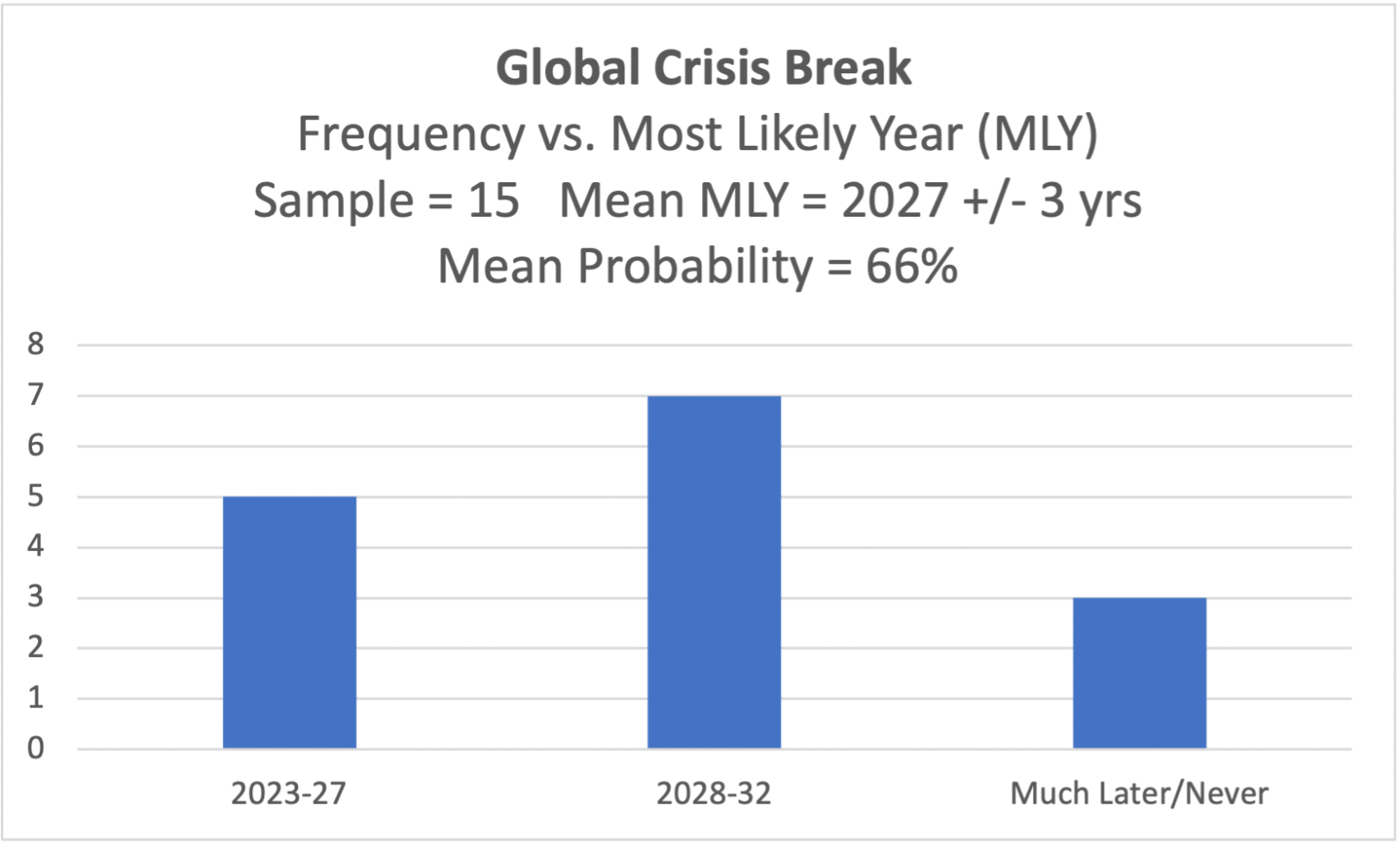
    We feel fairly confident in forecasting this break to occur about 2027, much like the 2022 US midterm elections broke the crisis in American democracy. Specifically, this study suggests a 66 % probability that the prevailing Crisis of Global Maturity is likely to turn into hope for solutions about 2027 +/- 3 years.  This global crisis break, would then allow renewed efforts to think seriously about solutions — leading to our forecast of Global Consciousness about 2030.

    Forecasting Global Crisis Break

    A societal crisis is much like a bodily fever. Both grow to severe levels that may not be sustainable. Things get worse. Threats abound. The future looks grim.  Yet — at some point the fever breaks. The crisis turns from pessimism to hope. 

    This study focuses on the prospect of a break in the global crisis of climate change, more pandemics, global recession, inequality, and other threats to come. We aim to forecast when and if today’s nagging pessimism will break, like the break in a fever. When a majority of people around the world become optimistic about the future. When prevailing attitudes switch from doom and gloom to faith and hope. 

    Our earlier Trend Analysis defined 15 trends driving the Crisis of Global Maturity and 12 trends acting to resolve it. Here’s a quick summary of highlights on the crisis: 

    The Crisis of Global Maturity

    Global Pandemics Likely to Continue. The Covid pandemic is but the latest threat from more global infections to come. The Global Health Security Index recently noted “every country, including the US, remains dangerously unprepared for … future pandemics.”

    Democracy in Decline.  A PEW Research Center poll finds that only 17 percent of people in democratic nations are confident in the US as a role model of democracy.

    Probability of Disaster.  The Marien and Halal Study found a 60-70% probability of disaster from climate, pandemics, financial collapse, inequality, conflict, terrorism, water, cyberwar, etc.

    Majority Fear We Are Doomed. A New York Times Survey of 10,000 people found that  “56% think humanity is doomed.”

    UN Reports on Climate Are Dire.  The most recent report of the International Panel of Climate Change (IPCC)  warned that “Total societal collapse is likely unless major decline in carbon emissions is made soon.

    Related statistics added by Gerd


     Most Likely Scenario/Driving Forces for About 2026-28 

    To put this issue in sharper focus, we outline trends shaping up into a moment of truth. Here’s a scenario of what we think are key trends and driving forces likely to affect the mid-term, five-year planning horizon of about 2026-28:

    Climate Worsens but Provokes Action: The fires, droughts, heat, floods and other damage caused by climate change is almost certain to intensify. Fortunately, so will attempts to resolve the climate threat.  Biden’s $360 Billion program seems promising, other nations are doing the same. McKinsey Consulting expects business to invest $ 9 trillion per year alleviating climate change. The fear of relying on Russian oil and gas is driving a rush to energy independence and renewables should exceed the use of coal by 2025. (Washington Post, Dec 13, 2022)

    Democratic Enterprise Coming: ESG is now practiced in 90% of corporations and growing.  TechCast estimates a 70% probability that stakeholder governed corporations will enter mainstream use this decade.
    Global Recession Ends: Central banks are raising interests rates to reduce inflation, while global debt has doubled recently, making the downturn painful. The decline may be deep, but it should also run its course to produce renewed growth about 2024-25. This time, it is likely to be led by government spending and demand that remains strong. The collapse of the Tory government under Liz Truss in the UK refutes faith in “trickle down” theory (tax cuts, reduced public services, etc.), whereas the US programs under President Biden demonstrated that government can spur growth.

    AI Takes Off:  Our forecasting consistently signals that AI is likely to  pass the critical takeoff point about 2025 +/- 2 years. This will eliminate many routine jobs and create new creative jobs, and cause more subjective forms of thought to proliferate, as well as more disinformation. Automation will provide far higher level human attention, and the intelligence to do what seems impossible now. This newfound power of AI will also poses enormous risks, stressing the necessity to establish strong AI controls.

    Peak Trump:  It is increasingly clear that former President Trump and his associates are likely to be indicted for criminal charges, possibly sometime in 2023. The reaction of his followers could be violent, but the Department of Justice says it cannot allow the law to be disregarded. Trump’s associates could be charged first, thereby gaining more information to support an indictment against the former president and preparing the public for the worst to come. The US mid-term elections confirmed Peak Trump. Even GOP leaders are moving away from Trump, finally! In symbolic terms, this could play out as Dept. of Justice Chief Merrick Garland assumes the heroic stature of Saint George slaying the fierce dragon of evil.

    End of the Russian War Against Ukraine: The Russian military is nearing exhaustion, while Ukraine shows no signs of yielding, setting the stage for some type of negotiated settlement — as all wars do eventually. Ukraine may cede some territory to Russia, and it may agree to refrain from supporting NATO strategic arms. Putin and his generals are likely to be charged with war crimes.

    Decline in Autocracies: The Trump rebellion and Putin’s war on Ukraine seem to be failing, and Bolsonaro was defeated in Brazil. China’s turn to state control is condemned to harm economic growth and freedom. Iran is throes of rebellion. After the past decade of strongman rule, could this mark the decline of autocracy? But Netanyahu is following the Trump playbook in Israel.

    Continued Rights Movement:   Following gay rights,  #MeToo, BLM, we now see young women in Iran ignite widespread protests, with men also challenging the regime. After hundreds of deaths and thousands of arrests, the movement has moved beyond female dress to demand an open society that joins the modern world. Meanwhile, China’s failure to make zero-Covid policies work has discredited Chairman’s Xi’s power. The Russian people have been tamed temporarily, but the brutal costs of war build pressure for revolt. In these 3 nations, the “easy” work of industrialization and raising living standards is nearing its end,introducing the messy social demands now troubling the modern West. The fundamental need for freedom, respect, and equity is insatiable. Look for more demands that challenge power everywhere.

    US Crisis Break: The Mid-Term elections in the US punctured the Trump bubble, and public opinion has broken the fever of The Big Lie, rigged elections, and the other post-factual web of delusionary thought. Resistance to dumping Trump persists, but the national mood has shifted distinctly away from “crazy” and toward normal again. GOP leaders are left dazed and confused. Shell shocked. Tom Friedman called it the second greatest test of American democracy since the Civil War.  “We were dinged a bit,” he said. “But we won.” This US Crisis Break seems to be spreading not only in US politics but everywhere. Faith in the cryptocurrency mania collapsed, like a hi-tech Ponzi scheme. And tech superstar Elon Musk so bungled Twitter that he also destroyed his reputation of appearing invincible. The hard truth of reality struck again, as it always does.

    Study Results — Global Crisis Break ~ 2027 +/- 3 Years

    Round One of this study “eyeballed” these forces driving a break in today’s doom and gloom about 2025 or so, and the results below estimate Global Crisis Break at ~ 2027 +/- 5 years, with a strong probability of 66 %. The small number of “Much Later/Never” estimates speaks to the doubts that prevail. Our sample size of 15 is smaller than we like, but TechCast has learned that anything over 12 provides a good approximation of the rough answers needed for our purpose.


    A few experts voiced the doubts:  Peter King leads the opposing views by saying, “… we are on the verge of a planetary crisis… the initial phase of the breakdown by 2050 but the full consequences will be obvious in the second half of this century. And Young-Jin Choi thinks“I’m afraid there is little chance for a return to a past state of perceived normalcy or an imminent crisis break.”

    While more experts saw the likely change:   Paul Haase noted, “… we already see changes happening in the right direction.”  Owen Davies has misgivings but agreed, “Yes, the world will be a better place in five or ten years… Eventually, we will look back and recognize that things have changed for the better.” And Victor Motti stated, “This is a major driving force that will accelerate the pace of approaching the global crisis break point.”

    TechCast studies like this strive to be objective and even handed, while also providing inspiration for addressing the hard work of change.  While we respect the voices of those who argue global crisis break is likely to happen much later or never, we also suggest they represent what Arthur C. Clarke defined as a “failure of nerve.”  We know that crisis breaks are common, and we can see the driving forces noted above are moving toward resolution. The main obstacle, however, is beyond knowledge — summoning the courage to challenge widely held views that such a dramatic change will happen. The fear of being proven wrong. TechCast thinks the issue is so crucial that we are prepared to risk the stigma of a mistaken forecast. We also think these driving forces are so robust that global crisis break is not only possible — but that it is near.  The most likely time frame may be 2027 +/- 3 years, but it could easily happen at the lower end of this margin — 2025 or so. 

    Conclusion: Finding Faith and Hope
    Global Crisis Break is not to be confused with our previous forecast for Global Consciousness about 2030 +/- 5 years.Our best estimate suggests a 55% probability of a “global consciousness” emerging about 2030 +/- 5 years to address these threats. We define Global Crisis Break as the point when the bulk of opinion swings from pessimism to optimism, much like the mood shift that is so striking now about the US. Like the eventual break in a fever. The crisis is still there, but today’s pervading sense of doom is replaced by faith and hope. Crisis break would be the first step toward global consciousness. The solution may not be in sight yet, an energizing faith drives the search for options.
     
    This conflict between evidence and skepticism is one of our great obstacles today. Many find compelling reasons for hope and optimism, but many others simply cannot accept the possibility of anything good. They condemn hope as unrealistic, utopian, idealistic, even naïve. The public seems divided roughly at 30-40% skeptics, 30-40% convinced, and the remaining 20-40% confused or undecided.
     
    Conflicting views block needed change. That’s why crises continue. Negative attitudes can become self-fulfilling prophecies because they discourage action. Doom and gloom are deadly. Change is only possible with hope for a better future. And hope can only exist with faith in forces for good.
     
    To find our way through this critical test of civilization, we can trust in these universal forces brought us through chaos. Civilization survived the fall of Rome, the Dark Ages, various plagues, World Wars I and II, and a cold war bristling with nuclear weapons. Today, the “Trump rebellion” is alarming, but a similar rebellion came from left-wing radicals a few decades ago. During the 1960’s, the US was struggling to contain social conflict that it flared into riots, takeover of public buildings, and bombings. That too passed.
     

    Now we need to have faith in the powers of social evolution that has proceeded steadily from an Agrarian Age to an Industrial Society, then the Knowledge Age, and is now moving to an Age of Consciousness. To also have faith in the goodness of humanity that drives this evolutionary progress. If we can find these sources of faith, then we can also find the hope that allows us to make bold changes. Otherwise, prepare to face disaster.

    Bill Hallal