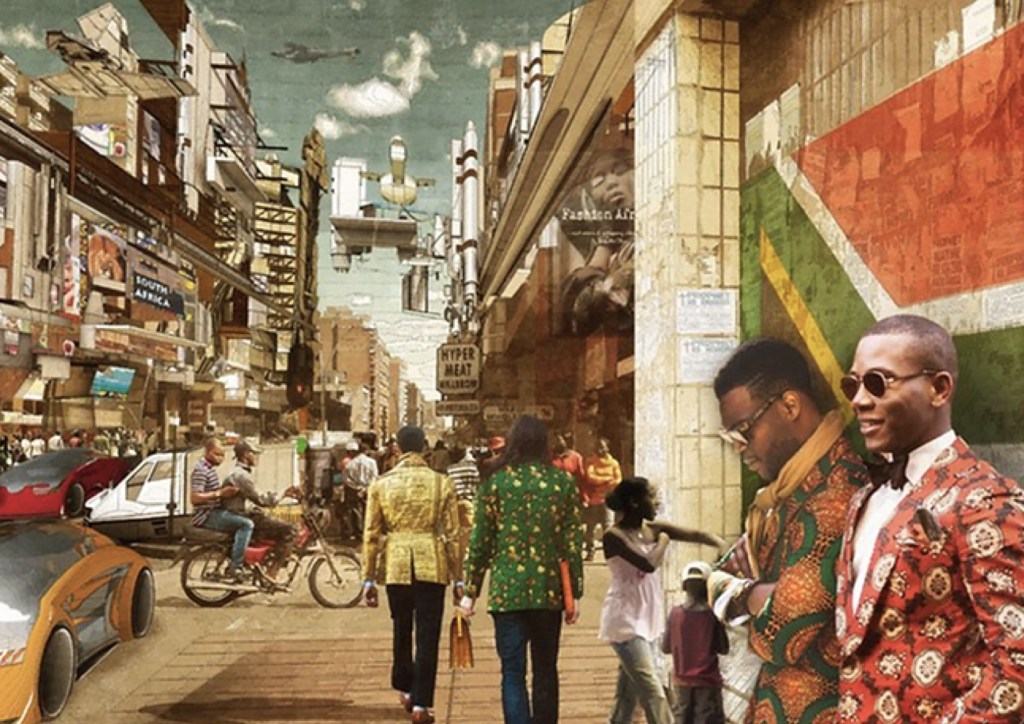
Image Source: Ikiré Jones Note: Lekan Jeyifo (b. Nigeria) and Walé Oyéjidé (b. Nigeria, 1981) – “Johannesburg 2081 A.D”, Africa 2081 A.D. series, 2014. Digital print.
Have you ever felt uncomfortable or unrepresented when you encounter images in Futures Studies? Have you ever thought about who and what this visual language represents or benefits? Sometimes these images are rooted in colonialism, and we don’t even notice this influence.
However, breaking with hegemonic discourses is essential when using images in Futures Studies. It is time to connect with other forms of thinking, to become a plural society, and to hear other voices. It’s the moment to build different ways of being and getting involved with the world.
This is worth reflecting on, as Decolonization is a worldwide phenomenon – from Australia to Hawaii, from the Philippines to Argentina. It is a pivotal moment in human history where we have the opportunity to make the language of Futures Studies more universal and inclusive through images.
Humanity is on the brink of existential transformation, but we’re blind to the deeper processes of change. To recognize the mind-blowing possibility space of the next decade, as well as its catastrophic risks, we must grasp the patterns of history to understand how they can illuminate today. Rethinking Humanity takes viewers on a whirlwind tour of the rise and fall of civilizations through a powerful lens that makes sense of the past, so that we can step into the present and create our future.
Check out the latest film about the future from Gerd Leonhard.
This film is a passionate call for action to everyone, and specifically to all participants of #cop27egypt – we must act now to ensure #thegoodfuture ! Implement now, have courage!
“Our attitude contains our future, and the choices we make today create our future. We are to be architects of the future – not its victims.” Buckminster Fuller
This fast-moving and (imho) riveting film depicts two alternate #2030 scenarios: the lousy future and the good future, covering topics such as #climatechange and the challenges of exponential technological change (yes, my fav #techvshuman topics), from both angles. At the end of the film, you’ll get to vote which one you think is more likely.
Note: If you’ve seen enough dim views of the future already you can skip directly to the good future by using the 6th shortcut, below::)
Let me start by saying that the future is not what it used to be! There have been many times in human history when the future seemed utterly uncertain, or (of course) dark and dystopian. But there has rarely been a time when so many people around the world question the future in such a fundamental way, as they do today.
The Danish philosopher Soren Kierkegaard once said that life must be lived forwards but can only be understood backwards. Well, that may have been true in 1845, but nowadays I think we must learn how to ‘remember the future’; to travel forward 7 to 10 years, and to then return with what we’ve learned …. in order to make better decisions TODAY.
Hence, I humbly present this film, taking us forward to 2030, twice: the dark and lousy future and the more heavenly one.
You may ask: What’s the point of even envisioning a good future when the present is already such a hopeless mess? Well, I think it matters a lot HOW we think about the future – because “as we see the future, so we act, and as we act, so we become”, in the words of American futurist Barbara Hubbard.
Many thanks to Sylvain Collet (Editor and Co-Producer) and James McCabe (Scriptwriter)
Recent polls in Europe and USA show that 45% of young people say climate change negatively impact their daily function. Worse, 75% view the future as frightening; among them, 59% believe humanity is doomed. They are being dismissed as being everything from inexperienced to fragile, but according to world renowned sociologist, Hartmut Rosa, they are not misfits, poorly adjusted, or fragile. “They simply don’t thrive because they see clearly the writing on the wall: That there is something wrong with our society.”
So, what do they see that the rest of the (adult) world does not see?
To get a feel for this complex problem, I’ll point out five aspects:
Feeling the frost melting after the pandemic winter in Boston, I took to the road in search of intentional communities across the Americas and Europe. I explored the eco-villages of Appalachia, ashrams of Sao Paulo, and Esoteric societies of Turin.
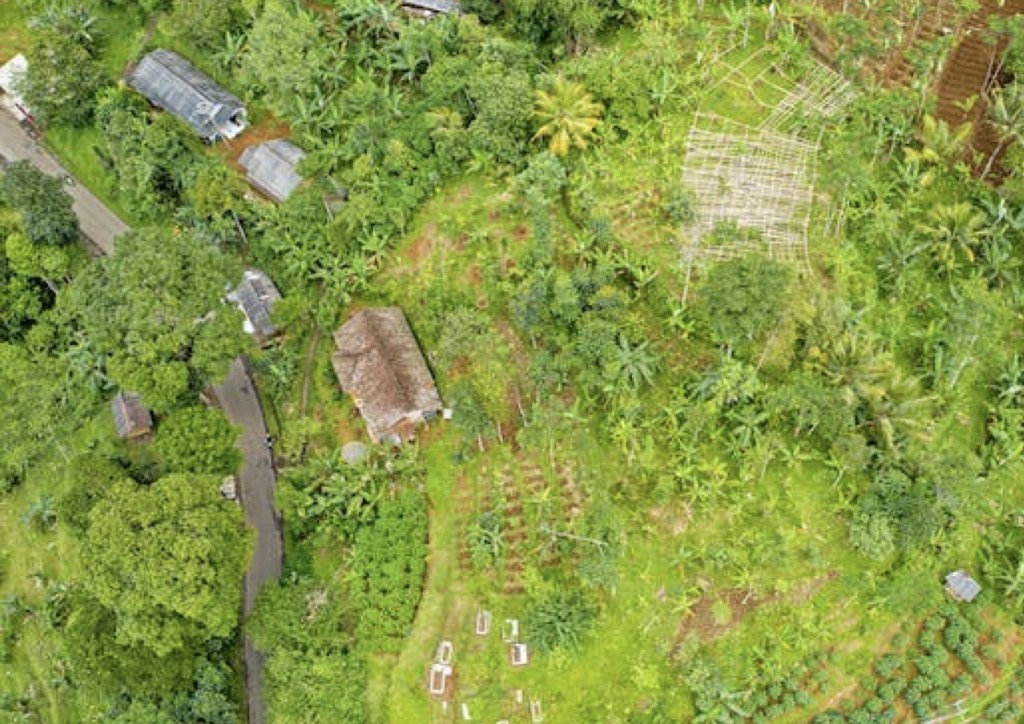
What I found is a keyhole view into the next evolution of human consciousness and a nurturing path towards climate action. The similarities among communities, regardless of location or belief, teach us what truly nourishes the human spirit and how that is fundamental to humankind’s survival on planet earth.
Above all, communities show us that climate action is an invitation to evolve our lifestyles. The communities I visited have shattered my basic assumptions about the pathway to a sustainable future. What if restoring balance with the planet was a byproduct of living with abundant beauty, deeper connections, purposeful work, and acting-out our wild imaginations?
A 2022 report by UNEP finds that, currently, we are falling far short of the goals set in the Paris Agreement, the international climate treaty, with no credible pathway to reaching the 1.5°C warming limit in place. “Only an urgent system-wide transformation can avoid climate disaster,” it states. More than ever, it is vital for every industry, including the creative sector, to drastically change its practices – but also to point audience attention to the climate and ecological emergency with whatever tools we have available to us. In fact, another recent report has discussed the potential capability the creative industry has to lead the way with good practices.
There have been several impactful creative projects alerting and educating audiences about the climate crisis and working to push for more sustainable design practices. Below, we revisit five of them, seeing how typography, research projects, and material-based innovation can call for action and facilitate education.
This session is from the event ‘Building Climate-Positive Organizations’ hosted by IFTF Vantage, and features Dr. Elizabeth Sawin, Co-Founder and Co-Director of Climate Interactive, and Jake Dunagan, IFTF Governance Futures Lab Director. Institutions and norms are being pushed to a breaking point by failures in our basic economic, political, health, and social systems.
These institutions are failing just as we face an even deeper challenge with our core planetary systems. This is a moment of civilizational transformation or collapse, a moment which requires better frameworks for thinking and doing that consider whole systems and extended timeframes.
Lea Namugerwa, a climate activist from Uganda, asked world leaders that were going to take the podium to speak like they are in an emergency, because that’s what it is.
Besides being a Distinguished Fellow at Harvard Law School and Carnegie Mellon University’s College of Engineering at Silicon Valley; Vivek Wadhwa is a successful author of books such as “The Driver in the Driverless Car: How Our Technology Choices Will Create the Future”; “Your Happiness Was Hacked: Why Tech Is Winning the Battle to Control Your Brain—and How to Fight Back”; “The Immigrant Exodus: Why America Is Losing the Global Race to Capture Entrepreneurial Talent”; and “Innovating Women: The Changing Face of Technology”, amongst others.
Vivek will discuss how exponentially advancing technologies have made it possible to solve the grand challenges of humanity, such as clean water, disease and health, energy, and food, and disrupt entire industries. He will highlight how we will be able to cure diseases such as cancer within this decade, launch a truly green revolution in agriculture, provide inexpensive clean water to billions of people, and transition to an era of unlimited and almost free clean energy. Finally, Vivek will discuss the opportunities for Dubai and the Middle East to lead the technology revolutions and build trillion-dollar industries.
Several European leaders at COP27 announced funds to help poor nations recover from loss and damage caused by climate change. The United States was silent.
SHARM EL SHEIKH, Egypt — For 30 years, developing nations have been calling for industrialized countries to provide compensation for the costs of devastating storms and droughts caused by climate change. For just as long, rich nations that have generated the pollution that is dangerously heating the planet have resisted those calls.
At the United Nations climate summit last year, only Scotland, the host country, committed $2.2 million for what’s known as “loss and damage.” But this week, the dam may have begun to break.
On Sunday, negotiators from developing countries succeeded in placing the matter on the formal agenda of this year’s climate summit, known as COP27, or the 27th session of the Conference of the Parties.
“The addition of loss and damage on the agenda is a significant achievement, and one that we have been fighting for many years,” Mia Mottley, the prime minister of Barbados, said on Tuesday. “We have a moral and just cause.”



 The Good Future Project