
by TGFP member Chris Nolan, film maker and producer
Also available on Medium and Gerd’s blog.
In 1975, New York was a crime-ridden nearly bankrupt metropolis with garbage piling up on sidewalks. It certainly wasn’t a tourist destination but more akin to the dark dystopian Gotham City that inspired the Batman movies.
In a last-ditch effort to avoid bankruptcy, the city turned to President Gerald Ford –– who famously told the city to “drop dead”. It was that bad. Now on its own, NYC had to find a way to flip the script and promote a more positive image. So it turned to Madison Avenue for help. Not surprisingly, most agencies passed thinking the city was too far gone.
Everyone except for two brave women, Mary Wells Lawrence who ran Well, Rich and Green Advertising and Jane Maas the real-life inspiration for Peggy Olson in “Mad Men”, who set out to re-brand a city like a product.
The result was the famous “I Love New York” campaign which completely changed the city’s story and bad reputation. Overnight, NYC became a tourist mecca.
Ten years later Chiat/Day, the Los Angeles ad agency I worked at, would orchestrate the same rebranding idea for its hometown. In the 1980s, L.A. was a smog-filled city with tense race relations – certainly not the food, fashion, and arts mecca it is today. The “I Love L.A.” campaign featuring the Randy Newman song of the same name celebrated its unique neighbourhoods and cultural diversity helping to change it into the vibrant city we know today.
FLIPPING THE SCRIPT
We live in world shaped by our stories. The stories we tell reinforce our perceptions and shape our reality. Marketers know this. It’s what a brand strategy is all about. We craft a brand story to trigger how a product is perceived and that becomes the brand identity. The two big filters that inform our perception are goals (dreams) and fears. Goals and fears are the essence of stories from a biologically and evolutionary perspective. They are also the essence of branding.
In the same way, the stories we tell reinforce and shape our culture and our future. If they amplify fears they exacerbate anxiety, worry, and uncertain mindsets. If they are positive, they trigger hope and inspiration.
Marketers also know how negative stories can erode trust fast. Australian business story expert, Shawn Callahan, explains that for every negative story you need a lot more positive ones to counteract its effects.
We now live in a time that some have called the golden age of dystopia. A continuous dose of fearful stories have created millennial preppers (a person who believes a catastrophic disaster is likely to occur in the future and makes active preparations for it) and other Armageddon mindsets. To overcome the impact of dystopian storytelling, we need to rebrand the future as though it were a product. Or in this case a product of our imagination. American futurist Barbara Hubbard would add, “As we see the future, so we act and as we act, so we become”.
My friend and partner in the Good Future Project, Futurist Gerd Leonhard, talks about two possible future scenarios in his wonderful video entitled “Twice Upon a Time” (or the ‘Good Future-Only‘ edit), Leonhard theorizes that mistrusting the future makes it very hard to give up the past and the present which makes it difficult to move forward.
It’s also important to factor in some neuroscience here. The brain tends to embellish and exaggerate fears and traumas. Like watching a film, the brain gets creative and fills in the blank frames of things we don’t understand or are uncertain of. In fact, studies show that fifty percent of what we think or say about our past is made up. Which means you might actually be living a story that’s not real.
What’s more, we continually look for proof in order to confirm that story. It becomes our belief and behavior. If we feel like a victim, then we will look for ways to reinforce that belief. And these half-truths become our attitudes, perspectives, and our identity –– both individually and as a society. As historian Yuval Noah Harari tells us, “Just as individual humans get caught up in the stories they invent about themselves so do entire societies, cultures, and nations.
TALE OF TWO FUTURES
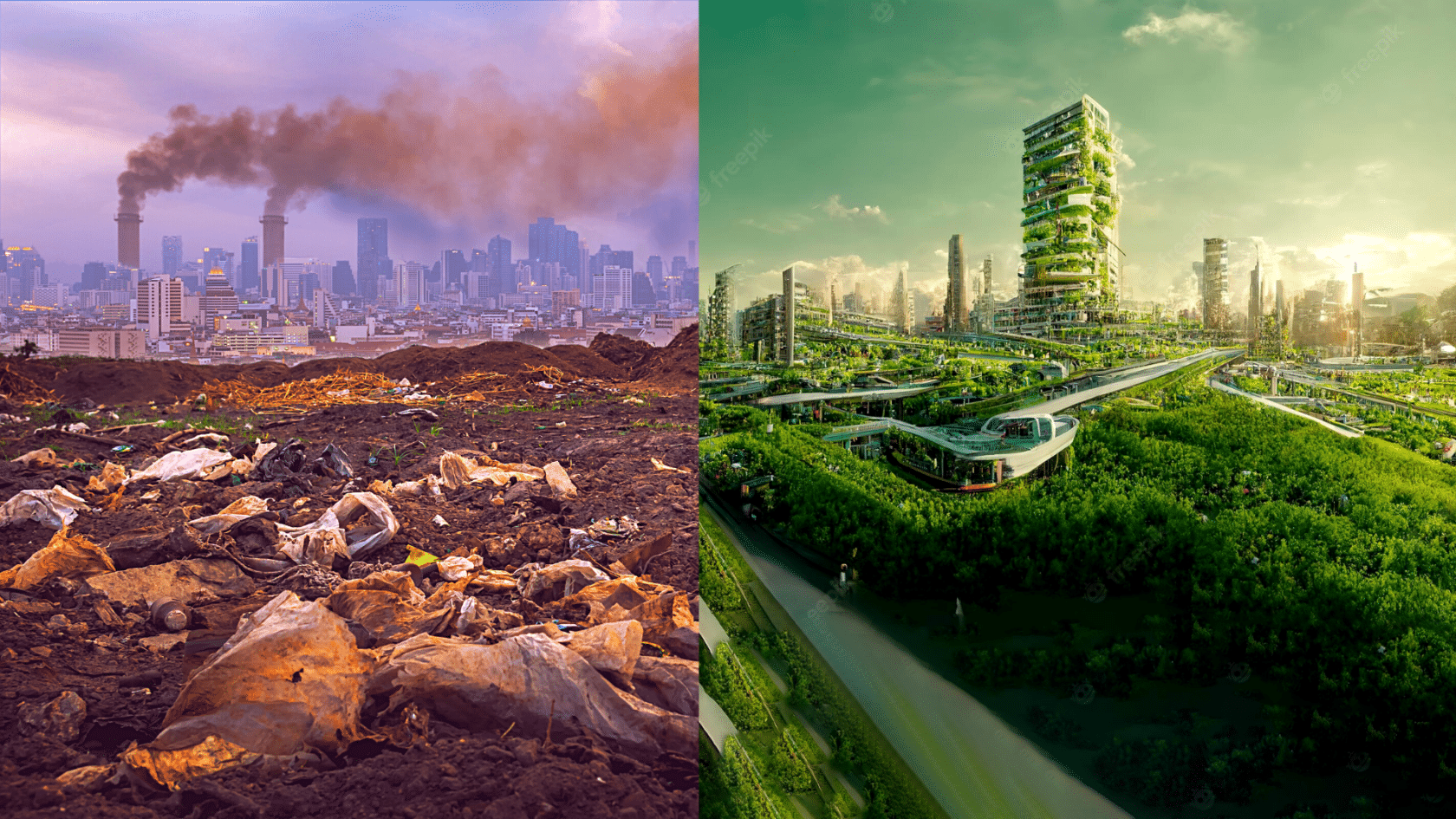
“It was the best of times, it was the worst of times, it was the age of wisdom, it was the age of foolishness, it was the epoch of belief, it was the epoch of incredulity, it was the season of light, it was the season of darkness, it was the spring of hope, it was the winter of despair.”
― Charles Dickens, A Tale of Two Cities
The famous opening paragraph of A Tale of Two Cities is based on the perception of the times. The best and the worst. It’s an apt phrase to describe the context of where we are today. You might call it A Tale of Two Futures. So is it the best of times or the worst of times? Is it an age of incredible knowledge, amazing technological breakthroughs, and abundance? Or one of climate change hubris, global inequity, distorted social media, and unethical technology?
Of course, our modern world is unlike anything Dickens could have imagined. In the author’s day, time was linear and local with everything a day’s walk with a person’s life typically marked by a few notable events. Today, everything is global and accelerating at massive exponential speed. It’s an era I call VUCA MAX during which an estimated 250 years of change will take place in just ten years.
But Dickens also understood that the stories we tell create our future. In his writing, he approached technology with hope in its ability to magnify human power, to provoke dreams, and ignite spiritual meaning. He believed that technology’s true utility set the future apart from the greed, the wastefulness, and the pollution of mainstream Victorian society.
In fact, on a whole, the generations before us generally celebrated future progress with awe and wonder. Whereas today, people around the world question the future and even dread it. 70% of young people under 40 years of age feel humanity is doomed and more than three-quarters of adults (76%) feel the future of America is a significant source of stress. Never in human history has the future believed to be so uncertain.
But the fact is the world is getting better and better every year with a compounding effect creating what Kevin Kelly, founder or WIRED magazine, calls “A continual progress toward a better world or – Protopia”. Protopia may not be as newsworthy as apocalyptic climate visions of cities underwater, burning rainforests, geopolitical shifts, disruptive markets, and social distrust but we are – as futurist Peter Leyden claims – really about to enter what could be a new age of Enlightenment. Not just mind-blowing technology but the kind of human evolutionary progress that will rival the Renaissance.
Indeed, the future is actually much better than we think (as Gerd says in this video).
Exponential converging technology is transforming scarcity and poverty into an age of abundance. Energy and water are becoming cheap, clean, and safe. As the cost of energy continues to drop, vertical farming and desalination will become commonplace further accelerating the eradication of hunger.
Ubiquitous AI and robotics are not replacing humans but expanding human potential, longevity, completely connecting the world, and accelerating innovation to solve the planet’s greatest challenges. Billions of people around the world who once lacked access to quality education can now create positive change for their families and communities.
STORIES ARE A SELF-FULLFILLING PROPHECY
Today, Iceland has 100% renewable clean energy and a thriving eco-tourism business. There are seven times more tourists than locals. But, it wasn’t always like this. In the 1970s, Iceland was dependent on imported coal and oil. To say the least, it was not a big tourist destination.
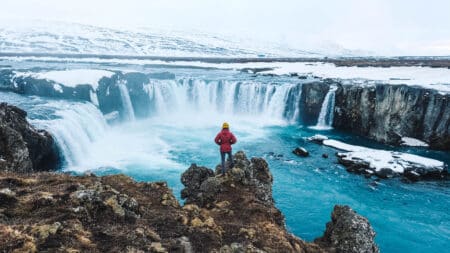
The change didn’t happen overnight. But it started with a new story that Iceland could be a model for clean sustainable energy with the help of a profound and unified vision, huge adjustments, and realigned investments.
Change for the better can be uncomfortable. It can be frustrating and seem impossible. And it takes commitment. But ask Iceland if it’s worth it.
Again, if you have the right story, you can rebrand a city, a country, and even a planet.
YOUR FUTURE SELF IS A STRANGER
“The future ain’t what it used to be.” Yogi Berra
Another reason you might be having such a hard time perceiving a positive future is because there’s a stranger in it. And it’s you!
Jane McGonigal a futurist at the Institute For The Future explains, “It’s a neurological fact that when you think about yourself 10 years in the future, your brain treats the person that you’re thinking about as someone you’ve never met”.
Take a moment to imagine yourself in 2035. You’ll probably see your future self as someone you don’t know so, as a result, you don’t think as much about the future as you should. This is why many put off saving or planning for retirement.
This is due to a glitch in our medial prefrontal cortex, the part of the brain that tells you the story of who you are. But if that part of your brain treats your future self like a stranger, how can you convince yourself to care more about a future you? Or the future of the planet? How do we build courage and overcome the fears of an uncertainty tomorrow? How do we acquire a future mindset in order to shape our future story on our terms?
One way is to be aware of the story we are feeding ourselves right now.
FEAR WOLF AND COURAGE WOLF

A Cherokee elder proclaims to his grandson, “A terrible fight is going on inside of me. It’s a fight between two wolves: the fear wolf and the courage wolf. The fear wolf is full of negativity, mistrust, lies, and hopelessness. The other wolf is full of positivity, trust, love, and hope.” The grandfather looks at his grandson. “This same fight is going on inside of you.”
Upon reflection the boy asks, “Grandfather, which wolf will win?” The elder Cherokee replies, “The one you feed.”
In contemplating this folktale, we can see the connection to the story we tell ourselves individually and collectively. And the story we tell ourselves has more power to create a brave, bold, positive world than we may think.
Sure, we can get beaten down by the dark narratives, the trauma of the pandemic, climate Armageddon, worries about global and economic turmoil, dread of relentless disruption and the dark thunderstorms of unceasing change and turmoil. Yes, we can become overwhelmed, paralyzed, and let the fears of the future fill in the blank frames of uncertainty with a narrative of negativity that becomes our frequent mindset.
Or we can starve the fear wolf and feed our courage wolf –– which is very hungry. There are always multiple possible future scenarios. We need to ask ourselves what is our preferred future? What is the story we want to feed ourselves?
THE FUTURE IS A MINDSET
“If you change the way you look at things, the things you look at change.” –– Wayne Dyer
Kevin Kelly also tells us: “It is extremely difficult to create a desirable future without first envisioning it. To imagine is really the first step in creating anything. Therefore, an essential chore for making a future we want to live in, is to imagine what it is like and how we get there”.
So how did New York City get there? By inspiring people, sparking their imaginations, and reminding them what was positive and exciting: Broadway, Central Park, the Iconic skyline, the city that never sleeps…
Soon, Woody Allen would write a movie love poem to the city entitled “Manhattan”. Martin Scorsese would direct and produce “New York, New York”. And Frank Sinatra would start spreading the news singing, “I want to be a part of it — New York, New York”, a song that revived his career as well as the city’s renaissance.
British philosopher James Allen wrote: Dream lofty dreams, and as you dream, so shall you become. Your Vision is the promise of what you shall one day be. Your Ideal is the prophecy of what you shall at last unveil.” So how do we dream lofty dreams that become the ideal prophecy of a desirable Good Future?
In this case, the first step is a worldwide campaign; an international movement of countries, companies, world leaders, influencers, celebrities, and people of all generations coming together to share how we perceive tomorrow.
To start the ball rolling, we have created “The Good Future Project”, a consortium and coalition of futurists and thought leaders with the ambitious mission to re-brand the future. Like the song says, “Start spreading the news.”






 The Good Future Project