• Mistrusting the Future makes it very hard to give up the past & the present – By Gerd Leonhard

    In this short video I address a key challenge that often surfaces in my work with clients: the fear of the future, and a general hunch that we “can’t trust the future” i.e. that nothing good will come of it, and that there is very little we can do about it. And of course, humans are usually evil and will act in bad faith. Few things could be more misguided – the future is better than we think! The future is created by optimists

    The future is not utopia or dystopia – it’s #protopia (a slow march towards a better future) *Kevin Kelly #thefuture is NOT just an extension of the present The future is already here – we just haven’t paid enough attention yet The future is not something that just falls down on us – it’s something we make (by action or by inaction). “As you see the future, so you act – as you act so you become,” Barbara Hubbard.

    #futurist #thegoodfuture #optimism #goodfutureproject 

     http://www.storiesfromthefuture.tv #thegoodfuture #techvshuman #futurist

  • Puerto Rican Towns Sue Big Oil – Truthout.org

    A group of 16 Puerto Rican municipalities has sued Chevron, ExxonMobil, Shell, and other fossil fuel giants for alleged violations of the Racketeer Influenced and Corrupt Organizations Act.

    The lawsuit, filed last week in federal court and described by plaintiffs as a first-of-its-kind RICO case, accuses Big Oil of colluding to deny the climate-wrecking impacts of their fossil fuel products. The towns argue that roughly a dozen oil, gas, and coal corporations and other actors are financially responsible for and should pay to cover the damages suffered during the catastrophic 2017 hurricane season, which was intensified by planet-heating pollution.


    Read more

  • Critically endangered tiny gecko comes back from the brink

    A species of critically endangered gecko, which is brightly coloured and the size of a paper clip, has nearly doubled in number since 2018, thanks to conservation efforts in collaboration with local residents.

    The remaining reptiles live in a 50-hectare patch of ancient forest, making them especially vulnerable to human activity. So in 2016, the Saint Vincent and the Grenadines Forest Department and conservation organisations worked with local residents to devise a species recovery plan.


    Read more

  • What is the fossil fuel non-proliferation treaty?

    Why is it needed?

    “For 30 years we have been making emissions reductions targets but the fossil fuel industry has been continuously expanding production,” Tzeporah Berman, chair of the initiative, said at Cop27. “We are trying to reduce the demand for fossil fuels without reducing the supply, which is like trying to cut with one half of the scissors. There is no treaty on what governments can produce and where and, without a treaty, we will be unable to bend the curve on emissions.”

    What’s the problem with more fossil fuel production?

    The problem is that there is far more coal, oil and gas in company and government reserves, and planned for production, than can ever be burned if global heating is to be kept to 1.5C above pre-industrial levels. Put another way, burning all the fossil fuel currently on companies’ books would guarantee climate catastrophe.

    Many major studies support this conclusion, including one that found 90% of coal and 60% of oil and gas reserves could not be extracted. In May, a Guardian investigation revealed that the world’s biggest fossil fuel firms were planning scores of “carbon bomb” oil and gas projects that would result in catastrophic global impacts.”

    What is the fossil fuel non-proliferation treaty?


    Read more

  • ‘Holdout Humans’: Chilling Glimpse Into Our Future if We Survive Another Million Years

    This article is available on sciencealert.com

    While Wells’s evolutionary models have not stood the test of time, the three basic options he considered still hold true. We could go extinct, turn into several species or change. An added ingredient is that we have biotechnology that could greatly increase the probability of each of them.

    Foreseeable future technologies such as human enhancement (making ourselves smarter, stronger or in other ways better using drugs, microchips, genetics or other technology), brain emulation (uploading our brains to computers) or artificial intelligence (AI) may produce technological forms of new species not seen in biology.

    If biological humans go extinct, the most likely reason (apart from the obvious and immediate threats right now) is a lack of respect, tolerance and binding contracts with other post-human species. Maybe a reason for us to start treating our own minorities betters.


    Read more

  • Beyond true and false – By Aeon

    This article is available at Aeon.com

    Buddhist philosophy is full of contradictions. Now modern logic is learning why that might be a good thing.

    An abhorrence of contradiction has been high orthodoxy in the West for more than 2,000 years. Statements such as Nagarjuna’s are therefore wont to produce looks of blank incomprehension, or worse. As Avicenna, the father of Medieval Aristotelianism, declared: Anyone who denies the law of non-contradiction should be beaten and burned until he admits that to be beaten is not the same as not to be beaten, and to be burned is not the same as not to be burned. One can hear similar sentiments, expressed with comparable ferocity, in many faculty common rooms today. Yet Western philosophers are slowly learning to outgrow their parochialism. And help is coming from a most unexpected direction: modern mathematical logic, not a field that is renowned for its tolerance of obscurity.


    Read more

  • Shrinking the Economy to Save the World

    For many economists, the coming demographic apocalypse is a problem only insofar as it will damage the gross domestic product. Though the GDP does not speak in any meaningful way to people’s actual quality of life, it remains an obsession of policy-makers around the world, who accept the premise that a growing GDP is a sign of a healthy economy and that a rising population is a key component of that equation. In a March working paper, Charles Jones, a professor of economics at Stanford University, wrote, “When population growth is negative…living standards stagnate for a population that gradually vanishes.” Conversely, “an ever-increasing population benefits from ever-rising living standards.” As is typical in mainline economics, “living standards” here are defined by GDP per capita, the number you get when you divide a country’s gross domestic product by its population.


    Read more

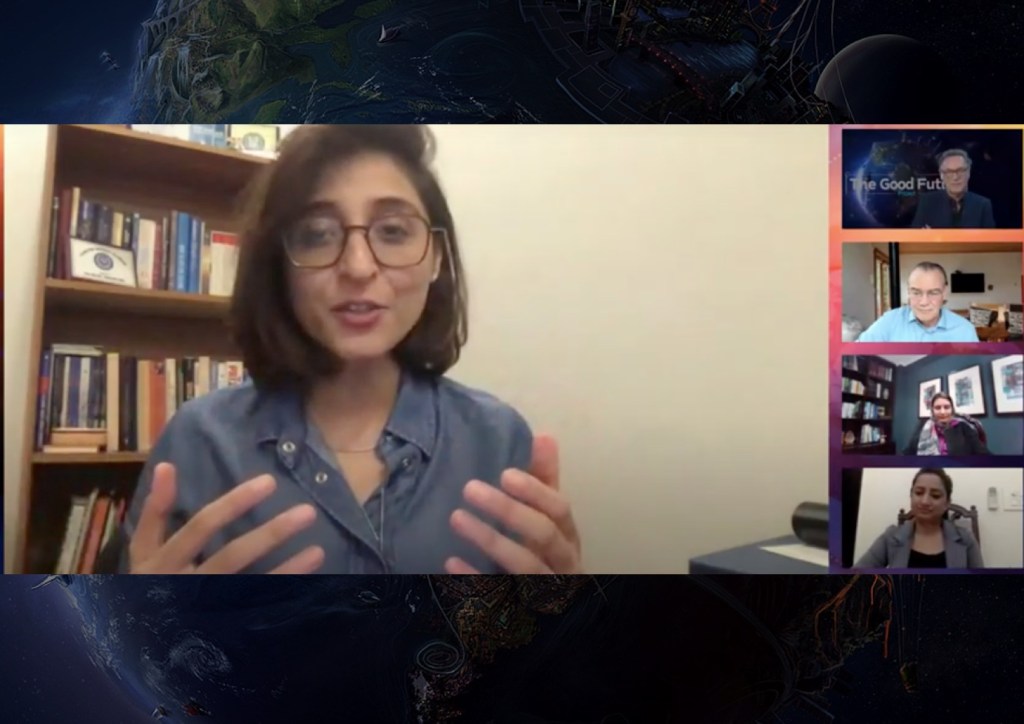
  • The Good Future Project Inaugural Event Recording – 23-10-22

    This event features Gerd Leonhard, Futurist, Humanist and the Founder of The Good Future Project (TGFP) and TGFP members Peter Leyden (Futurist, Berkeley / California) Puruesh Chaudhary (Futures Researcher, Pakistan), Chhavi Jatwani (Food Systems Designer, India / Italy) and Dr. Nisreen Lahham (Futurist, Cairo).

    Together, we explore three core topics (technology, climate change and new capitalism) that we believe encapsulate the key challenges and opportunities, and focus our efforts on starting a movement that changes the narrative of how we see the future, and propels us to create it.


    Read more

  • Climate Change from A to Z

    Climate change is not only a threat, it is above all an opportunity to create a healthier, greener, and cleaner planet which will benefit all of us,” she began. “We must seize this opportunity—we can achieve a win-win in both ecological conservation and high-quality development. . . . We need to walk the talk; if we do this together, we can do this.”

    “When it comes to global warming, we know that the real problem is not just fossil fuels—it is the logic of endless growth that is built into our economic system,” Jason Hickel, an economic anthropologist at the Autonomous University of Barcelona, has written. Climate change can’t be dealt with using the tools of capitalism, because it is a product of capitalism. It can be dealt with only by throwing off capitalism in favour of something else—a system aimed not at growth but at “de-growth.”

    “The difficult truth is that, to prevent climate and ecological catastrophe, we need to level down” is how the British environmental writer George Monbiot recently put it.”

    Discover more in this is an articulate, insightful and cleverly designed read by Elizabeth Kolbert.


    Read more

  • Another Billionaire’s Plan to Rebuild Social Media

     Last year, McCourt founded the nonprofit Project Liberty, a bold-bordering-on-improbable project to fix the internet. And on Monday, he announced his intention to step down from his chief executive position at McCourt Global to devote most of his time to the cause. “Tech is such a big important part of our lives. It should be optimised for people, not for time online, ad revenue, or rage,” he told TIME in a recent interview. He says the first step is a much more holistic approach that doesn’t put engineers squarely in charge of a societal project. “Last time around, we made a mistake by having the social scientists, governance experts, and civil society somehow be subordinate to the technology,” he says.

    McCourt believes that the dominance of a few Golathian social media platforms will give way to “a thousand Davids” that better cater to smaller communities with more specific interests and needs. This has already begun, with apps like BeReal and Mastodon gaining huge interest in the past half-year.

    Larkin, the new CEO of Project Liberty, boldly predicts that within five years, most social media users will be on a decentralised social media graph; McCourt says three. “We have an ambitious timeline in terms of creating real change fairly quickly, because I don’t think we have time,” Larkin says. “Social media is the main driver of undermining democracies, so we can’t wait around.”

    Challenges to Overcome

    Technologists who have worked in the decentralisation space far longer than McCourt are cautiously optimistic about Project Liberty. “I’m really excited that Frank McCourt and Project Liberty are bringing a different level of resources to this space than has typically been here. And I think that that could accomplish a great deal,” says Glen Weyl, an economist and a researcher at Microsoft Research. “At the same time, there are really challenging technical problems that can’t be solved theoretically. They have to be resolved through actual experiments, with real user bases—and they’re at the beginning of their journey of exploring that landscape.””


    Read more